



Walking around Milan with the thermometer exceeding thirty degrees, the sun beating down like a hammer and a heat from which there seems to be no escape, it is easy to come across men wearing jackets and ties despite the crazy temperatures. While in start-ups or creative companies in the city shorts are tolerated (but tank tops are not yet), a whole series of professions ranging from real estate agents to consultants, notaries, lawyers and various financiers have to deal with wearing tailored suits even in the middle of summer.
This raises two orders of problems. The first type concerns productivity: as demonstrated by a much-cited 2006 study, «performance increases with rising temperature up to 21-22 °C and decreases when the temperature exceeds 23-24 °C. Maximum productivity is reached at a temperature of about 22 °C. For example, at a temperature of 30 °C performance reaches only 91.1% of the maximum, i.e. the reduction in performance is 8.9%». The second concerns gender dynamics: women’s clothing can be much lighter than men’s, but in an office the temperature will tend to be kept very low because of the men in jackets and ties, triggering what CBC has defined as the “thermostat battle”.
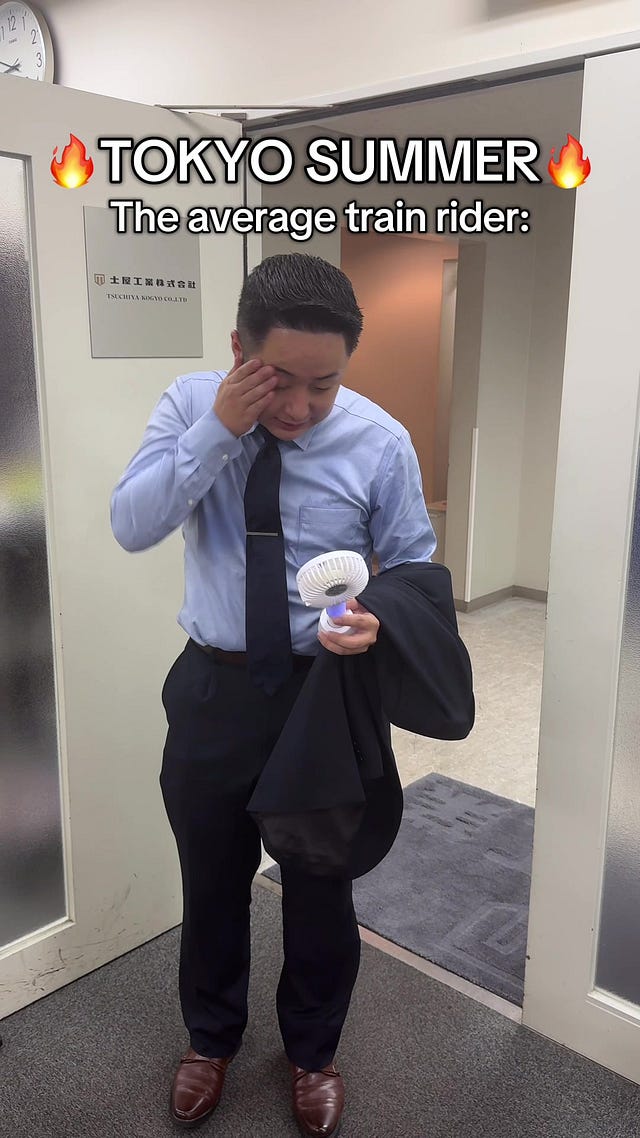
If the problem is (literally) burning in the West, in Asia the difficulty increases. The number of offices is much higher, the temperatures often higher too, and corporate dress codes much stricter than in Europe or the USA. In Japan, since 2005 the Cool Biz initiative has encouraged the famous salarymen (i.e. the country’s employees) to go without jackets and ties, but this year, between heat and energy saving, they went further: the governor of Tokyo invited workers to wear shorts. Something unheard of in the formal world of Japanese offices and actually in the whole world. Which leads us to ask ourselves, will climate change also become a sartorial change?



As nss magazine wrote in a recent article, the heatwaves of recent years are making cities one of the hot spots (pun intended) of the climate battle. According to UN sources, there is a 75% chance that the average temperature from now until 2030 will rise above 1.5 °C of the average of the last century. In cities, as the IPCC writes in the Sixth Assessment Report, the urban heat island effect can add up to 2°C to local warming. Tokyo is the most recent and striking example: Japan recorded the hottest summer since the end of the 19th century, and the national meteorological agency had to introduce a new climate category, kokusho (“cruel heat”) to describe the terrible but now habitual temperatures.
One of the most controllable sources of this problem is city design, not designed for such high temperatures, and which now would require the planting of hundreds of trees (not always possible) but also a whole series of re-designs such as permeable soils, reflective materials, reduction of asphalt, green roofs, shading of stops, depaving and climate shelters that cannot be implemented with a snap of the fingers. On the contrary, they would require a radical rethinking of urban planning as we know it.
So here the most immediate solution is to dress with less. It is a solution that has been operational for decades in much of the planet: it is the so-called “tropical officewear”, already typical of countries like Singapore, Indonesia, Brazil, Hawaii and the Philippines. In fact, for years the prophet of menswear, Derek Guy, has been telling millions of followers how Southeast Asian businessmen wear formal clothes in the heat, citing among the fabrics linen, Solaro and tropical wool. In short, fashion cannot be a solution but it can be a component of the solution to the fight against heat.

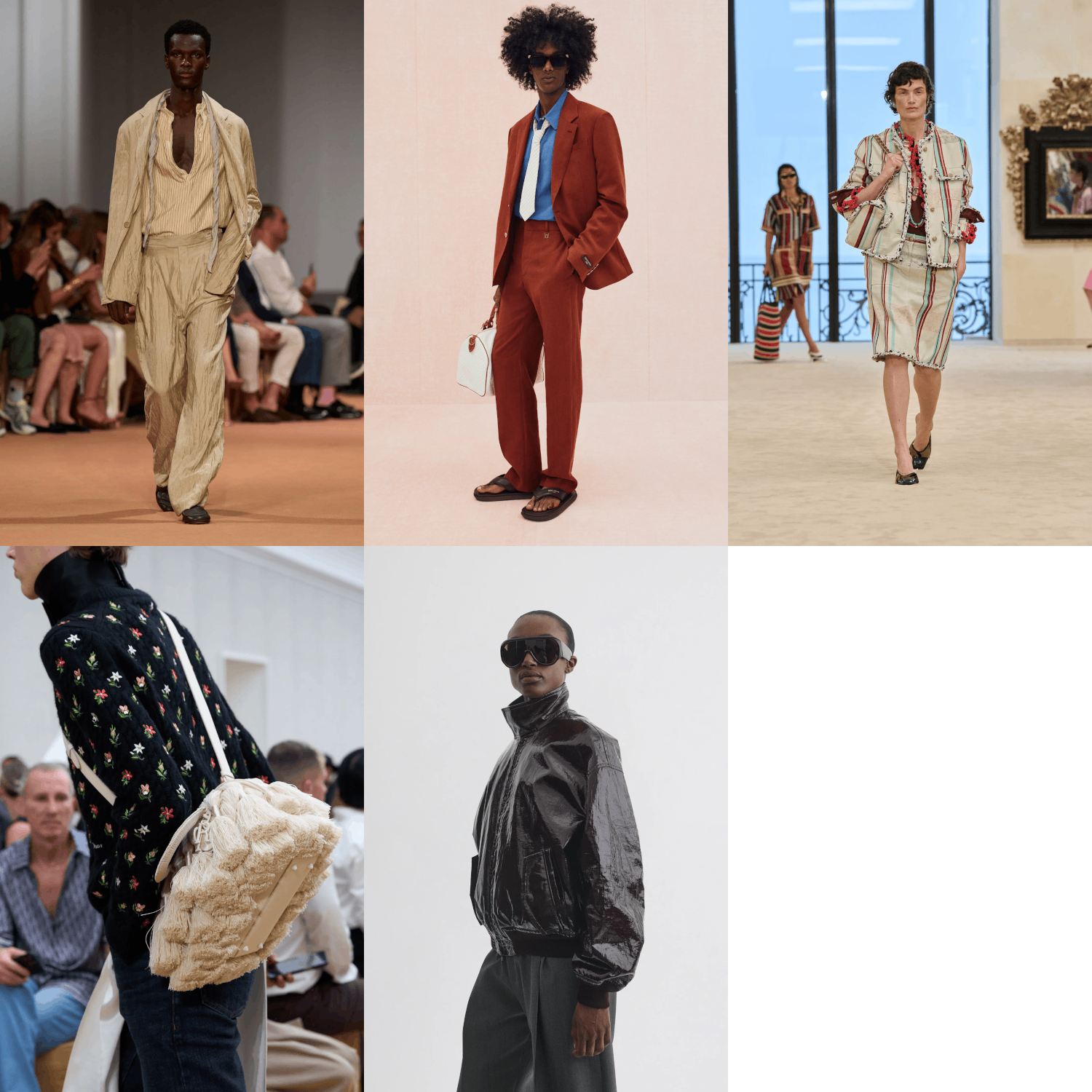
In addition to the rarer seersucker and tropical wools, associating linen with summer fashion is the default textile option. Not only has the fabric been used since the time of the pyramids, but as soon as summer arrives, every conceivable page and magazine starts talking about it as if they had invented it yesterday. And in reality what makes us understand how climate change has already pushed us to adapt as a society comes precisely from the fact that every single brand or retailer in every market category, let’s say from Uniqlo upwards, has started to offer linen wardrobes for the summer. It is interesting to see what luxury fashion has made of it, however, given that the margin for textile and design innovation in this field is quite minimal.
In the recent Chanel Cruise 2027 collection, for example, Blazy introduced several striped fabrics in a linen and cotton blend inspired by the tradition of Basque linen and produced on the looms of the ACT3 company. The idea here was to remake many of Chanel’s classic pieces, including tweed jackets and suits, in a linen that was smooth to the touch and maintained its appearance as a luxurious material. At Zegna, on the other hand, in the latest summer show in Dubai numerous linen suits were seen, a silk suit that weighed only 300 grams and even garments that incorporated cellulose into the fabric.
The examples are abundant anyway: from the “stabilized” linen with silk used in Louis Vuitton’s Pre-Fall 2026, to the linen transformed into tassels that cover one of the new Lady Dior bags in Jonathan Anderson’s debut for the brand and linen transformed into the textile base for almost an entire collection in Loro Piana‘s Resort 2026. With something ingenious, Phoebe Philo produced for the recent summer collection the Golf Jacket that looks like leather or PVC but is actually a “lacquered” linen canvas to appear shiny.
Elsewhere, for example in India, a highly successful brand like Kartik Research makes extensive use of linen by employing and collaborating with the many local textile artisans and thus giving its collections a deeper and more authentic cultural resonance. In short, the response of fashion (even outside of luxury if we think of innovations like Uniqlo’s AIRism) to an increasingly hot world has not been the abandonment of decorum, but its reinvention through textile innovation.

 Tiktok failed to load.
Enable 3rd party cookies or use another browser
The change that Tokyo has made official with the shorts of its officials, however, seems more the anticipation of a global norm than an exception to traditional dress codes. If we think about it, for example, today the fashion of the 19th century or early 20th century, when men were in suits all year round and women were suffocated by corsets, crinolines and long dresses even in the bathtub, seems impossible that someone could stand it. Perhaps it will happen like this in the future too: office clothing, which has basically remained unchanged since the European post-war period, was built for a climate and an economy that no longer exist and simply needs to be changed.
The process will have at least three directions. The first is material: technical and natural highly breathable fabrics or even new fabrics such as bamboo fibers will replace synthetic blends in professional wardrobes. The second is formal: the office silhouette will widen with wider cuts, fewer layers, less constriction at the neck and wrists. The third is cultural: as cities warm up, the very etiquette of clothing should evolve but always respecting the dress code of managerial offices which is perhaps the environment most impermeable to fashion that exists. But leaving the offices and moving on to how people dress on the street, things can change. After all, until last year seeing people wearing flip-flops in the city was crazy and today it is fashionable.
But returning to Japan, the Cool Biz initiative has already shown that advantages exist: in Japan, twenty years of lighter summer clothing have saved over two million tons of CO₂ per year, according to estimates by the Japanese Ministry of the Environment, without anyone missing the tie. The question is no longer whether the office wardrobe will change, but how quickly the rest of the world will manage to adapt to what Singapore, Jakarta and Honolulu have already been practicing for generations and which major brands around the world have already translated into clothes to buy.