


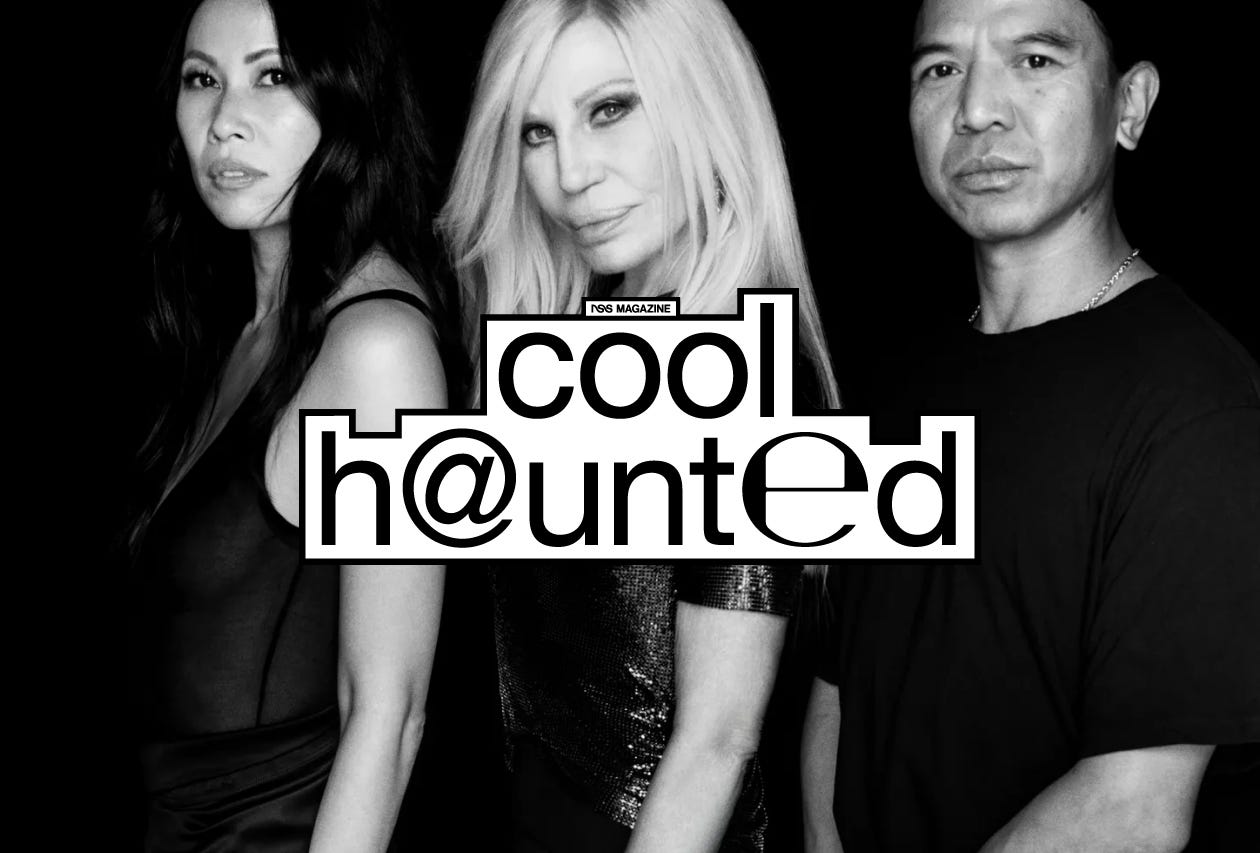
Donatella Versace is perhaps the most famous living fashion designer on the planet. There are certainly other celebrated ones, but her look, her hair, and her nature as a public figure are all signs of an iconicity that goes far beyond fashion and belongs to pop culture as a whole. It is perhaps for this reason that, as her first personal project following her creative directorship at Versace, the designer has entered into a joint venture with American group Revolve for a new brand whose name has yet to be announced and which will operate across several spheres: clothing, beauty, and even entertainment. But something doesn’t add up.
We know neither the name nor the general identity of the brand, which is perfectly understandable given the timing. But what is more interesting is that we already know when the first products will arrive, what kind of products they will be, and, above all, where they will arrive. And here is the intriguing part: the first product from this new brand built on the celebrity of an Italian fashion designer will be a beauty product, and it will be distributed virtually everywhere in the world except Europe, reaching the US and Latin America, the Asia-Pacific region (i.e., China), and the Middle East.
This business decision may leave idealists puzzled, but it actually makes sense. And its very peculiarity helps give us a picture of what it makes sense to do today for a business operating in that ambiguous melting pot now referred to as “lifestyle” — encompassing more or less all those everyday objects and experiences that can plausibly be associated with a particular creator. None of this is new to fashion: exploring areas beyond clothing in the strict sense has been common practice since the 1980s. But it is curious both to see how those external areas have become more prominent than fashion’s core business itself, and how today the global launch of a product with European allure (the selling point, after all, remains Donatella Versace’s role) can, in practice, bypass Europe entirely. But why?

The exclusion of Europe from the release rollout is no accident. As revealed by the Bain-Altagamma study presented in mid-2026, total global spending in the sector reached approximately €1,443 billion in 2025 and is expected to range between €1,440 and €1,470 billion in 2026, with growth of between zero and 2% at constant exchange rates. More specifically, the personal luxury goods segment (which includes fashion, leather goods, watches, jewellery, and beauty) closed 2025 at €358 billion, down 2% at current rates compared to 2024, but is estimated to expand by 2–4% in 2026, to between €365 and €373 billion. Within this picture, however, Europe represents the weakest link.
According to Bain-Altagamma, the European personal luxury goods market fell between 1% and 3% at current rates in 2025, settling at around €108 billion. And in 2026 things are no better: depressed demand, the disappearance of aspirational consumers, and rising retail rents and energy costs have made the continent the laggard in terms of commercial importance for fashion. The Americas are today the engine of personal luxury goods consumption, and the US in particular — given that the bulk of European sales comes from spending by American, Chinese, and Middle Eastern visitors in Europe, which this year, according to Bain, has also fallen by around 20% year-on-year, with spending by Gulf consumers declining between 15% and 25% due to regional conflicts.
Even for the major European luxury groups, in the first six months of 2026, Europe carries ever less commercial weight. For LVMH, Europe (France at 8% plus the rest of Europe at 17%) accounts for a combined 25% of revenue, compared to 25% for the United States, 29% for Asia excluding Japan, 8% for Japan, and 13% for other markets. For Kering, Western Europe represents approximately 30% of revenue, down 2% on a comparable basis, while North America accounts for 24% and is growing by 9%, the Asia-Pacific region (excluding Japan) for 30%, Japan for 7%, and the rest of the world for 9%. For Richemont, meanwhile, Europe accounts for just 24%, compared to the Asia-Pacific region’s 32%, the Americas’ 25%, Japan’s 10%, and the Middle East and Africa’s 9%.
One can therefore say that the Old Continent remains a market of considerable size — somewhere between 20% and 30% of revenue for the major groups (except for Puig, for which it represents 52% of sales) — but it is not a truly significant market in its own right. One might even venture to say that, without tourist spending, these percentages would be nothing short of disastrous. And perhaps this is why the new Donatella Versace brand will not initially be launched in Italy — perhaps also following the example of mega-celebrity brands such as Hailey Bieber’s Rhode, which arrived in Europe four years after its founding, and Beyoncé’s Cécred, which has yet to arrive at all. This opens up a further line of reasoning: since when has Donatella Versace been in the beauty business?

At the end of 2025, a Bain report showed that the beauty category represents the largest market share in luxury, surpassing both clothing and leather goods by one or two billion euros. While these latter two categories are stable or even slightly declining, beauty is in fact set to grow further. According to Fibre2Fashion, in the all-important Chinese market, beauty was the top-performing category of the year, while fashion and leather goods consumption fell by between 5% and 11%.
By mid-2026, the picture is more ambiguous: jewellery is leading growth and the fragrance category is performing strongly, while cosmetics is holding its own but growing far more slowly. It is not suffering as much as leather goods and footwear, the segment hardest hit by the downturn. Overall, however, beauty as a whole represents the most profitable bet for a brand entering the global market with a celebrity founder. According to the State of Fashion 2026 report by McKinsey and BoF, «the beauty sector shows the greatest propensity for increased spending across all markets and all market segments, with particularly strong momentum in China».
And the Chinese market itself represents that enormous treasure chest of wealth that almost everyone is after and for which, if you will forgive the expression, a designer-celebrity like Donatella Versace could be the skeleton key. At this point, it is reasonable to hypothesise that, given the countries that will be first to see this new product, and given that this product will fall into the beauty category, the new Donatella Versace brand will want to go straight for the profits in the fastest and most direct way possible. There is no other way to explain the logic of “signing up” an Italian fashion designer (at one point also of Haute Couture with Atelier Versace) for a brand that gives no priority to fashion and will not even launch in Italy. But fashion has accustomed us to this and more.