


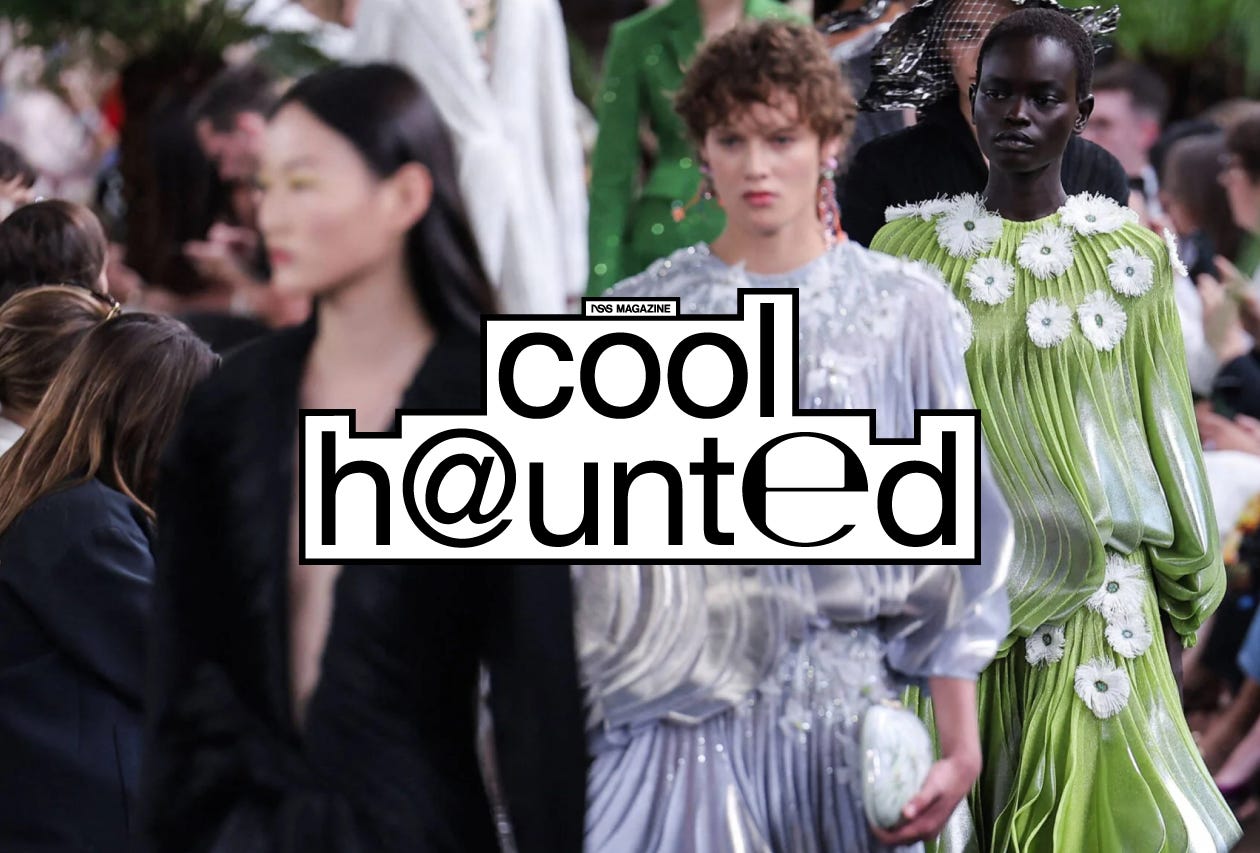
Do you also have the feeling of drowning in Dior and Chanel? With this Haute Couture season, Jonathan Anderson walked for the eighth time in a year and Matthieu Blazy for the sixth. It seemed (and, in some ways, it was) just yesterday that we were talking about both brands’ Resort shows and Instagram moodboards hadn’t finished posting the last details of the re-see that the carousel started spinning again. And after the summer break, in September, there will be another two shows. And almost certainly another two before Christmas arrives. Needless to say, at this pace the various collections start to merge into one another.
But there is also the doubt about how it is possible to creatively manage and handle in the smallest details such an intense output. Who can humanly generate so many ideas in such a short time and remain brilliant? At a certain point one will have to repeat oneself or end up insisting on oneself. To make a comparison, the same Armani Group has brought six collections to the runway since the passing of the legendary founder, which are the same as Chanel’s, but divided into three brands, which makes the production pace certainly more “calm” albeit equally demanding. But why, for mega-commercial brands like Dior and Chanel, is presenting every 60 days so essential?

The main factor behind this extreme presentialism concerns the nature of the modern client. «If we are faced with consumers who today are more stable, who change less, with a lower arrival of new consumers, we must increase the speed of innovation», said Luca Solca yesterday speaking with journalists gathered for the presentation of the latest BCG-Altagamma report. «Because these consumers who have been in the market for a while already have yesterday’s or last year’s products». If at the time of the democratization of luxury, which took place from 2000 to 2007, niche brands that became large producers still had to fill the world’s wardrobes with their iconic products, today much of that void has been filled.
«I believe the point [of so many shows, ed.] is precisely to bring novelties and capture the consumer’s attention», Solca continued. «And then build all the engagement activity, social media and start this “snowball” that feeds itself». The game actually works: even if 56% of total fashion clients don’t even know who the creative director of a given brand is, it remains true that a quarter of ultra-rich clients (i.e. half of the market) buy from a brand precisely because there is a creative director while, in 15% of cases, they stop buying from a brand for the same reason.
«The creative director himself may not be recognized», said Solca, «but the fact that the product is new, that there is something new happening is recognized». And indeed the data confirm that the effect of novelty, the oldest trick in the marketing book, works. «We have seen that traffic in Chanel and Dior stores has doubled this year while that of Hermès is down 30% in our surveys». Obviously the new, by itself, is not enough. Using the example of Chanel, Solca pointed out that Blazy has been successful because he brought «something new that is consistent with the sentiment of the market but also consistent with the history of the brand and its DNA and with what we as consumers have in mind about the brand».
That said, since the frequency of Chanel and Dior’s releases actually helps to create curiosity with clients and increase in-store traffic, one must ask whether such a continuous cycle of novelty impacts the status of Haute Couture as a category. For the home audience, i.e. the vast majority of the public, who watch the shows through screens and images, it becomes increasingly difficult to distinguish one collection from another, especially since ready-to-wear collections often include extremely elaborate garments and Haute Couture ones can include very simple ones. It is clear that the difference exists, but when everything is resolved in the image it is difficult not to lump all these shows together into a single continuous block.
And when the shows are so frequent and close together, almost taking your breath away, even the ideas of the excellent creative directors risk seeming repetitive and the work, for example, of defining a silhouette and a style flattens into a sense of déjà vu and repetition. The frequency of the releases, no matter how excellent, tends to deprive them of specificity and memorability given that the relentless bimonthly show schedule creates a nail-driving-nail effect in which the concept of the single show gets lost and one cannot even analyze those distinctive details that have now become too minute or too connected to niche artists to be understood.
The question, in the end, does not concern the quality of the work, which in both cases remains beyond discussion, but the context in which this work is shown and consumed. Haute Couture was born as a category of the exceptional, the rare, the unreplicable: a biannual appointment that had the time to settle in the collective imagination before the next one replaced it. Today that time no longer exists, and the consequence is not a devaluation of the garments themselves, but a devaluation of the moment, of that ability to amaze which, by definition, requires a minimum distance between one appearance and the next.
Haute Couture thus risks becoming one collection among dozens of others. Chanel and Dior will continue to produce extraordinary work, and their clients will continue to know it. But for everyone else, for that public that watches from afar and builds desire through images, the risk is that Couture stops seeming like an event and simply becomes yet another piece of content: beautiful, impeccable, and already forgotten before the next one arrives.