



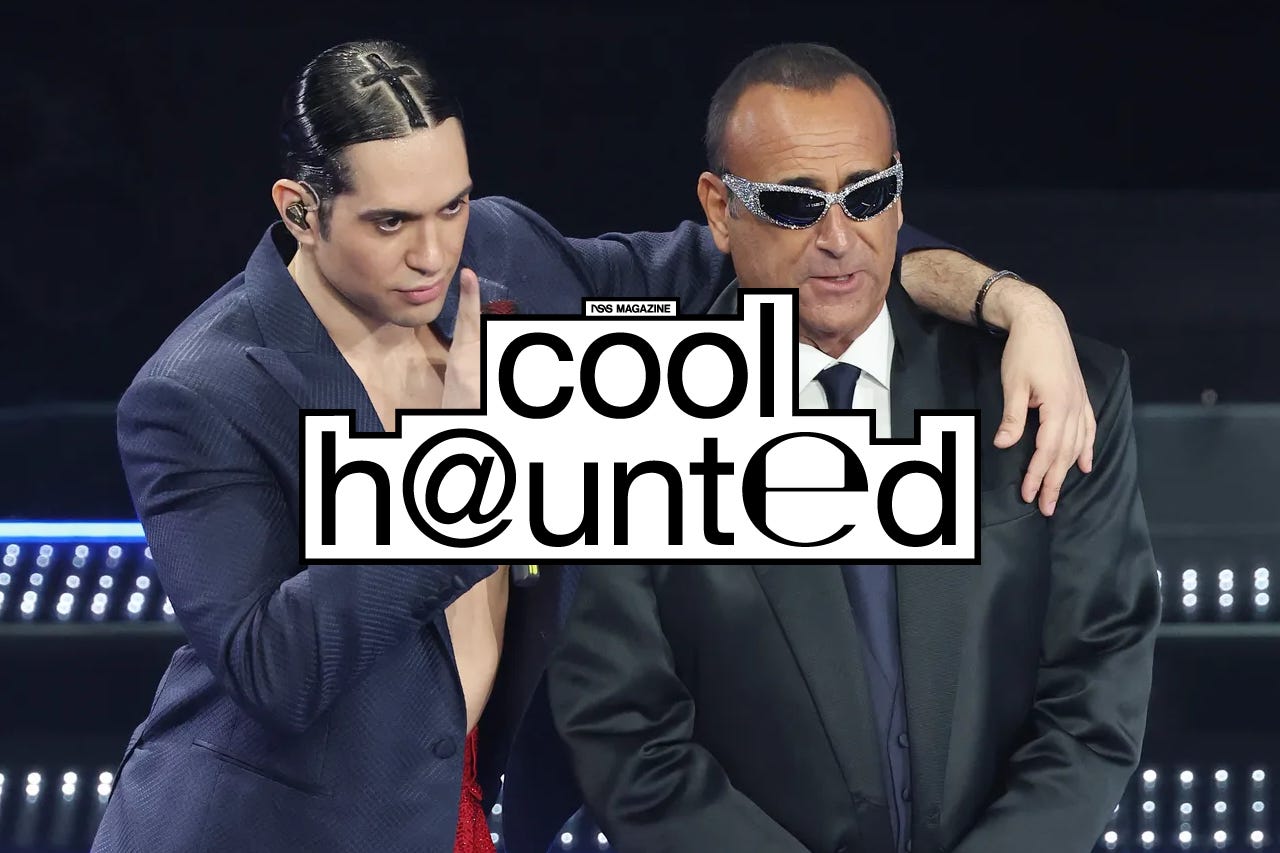
This season’s Fashion Week calendar is different from usual. With the exception of Bottega Veneta and Roberto Cavalli, no brand will show after 7 p.m. If for international media the decision seems strange, for the Italian press the news comes as a sigh of relief. Split in two, the Italian fashion system will have to choose whether to attend the most glamorous week or the most pop one of the year; the international crowd, instead, simply had to book food and accommodation earlier than usual - to avoid the drama of last summer, when the Paris Olympics blocked traffic and hotels during Couture Week. Yes, because this week, in addition to the ongoing Milan Cortina Winter Games, Northern Italy is hosting the Sanremo Festival, the holy week of Italian pop culture.
Between Sanremo and Milan, an intense flow of stylists, designers, project managers and influencers is forming, moving from Liguria to the Lombard capital to manage two of the most important events of their careers. On one side, the Italian Song Festival, patron of the country’s pop culture as well as a fabulous stage for talent seeking recognition on the creative scene; on the other, Milan Fashion Week, seven days of spotlights shining on the new stars of Italian fashion. There’s only one question: who will take care of the lights shining on Milan?

The Italian Song Festival cannot be compared to Coachella, Lollapalooza, let alone the Grammys or the Brits. There are no line-ups announced a year in advance, no overplayed song performances, no camping areas or recreational drugs - at least, not that many. For five days, from Tuesday 24 to Saturday 28 February, one of the most historically absurd, lengthy, camp and at the same time trashy programs of Italian television takes place at the Ariston Theatre. And the entire Italian audience - not to mention Eurovision viewers - whether jokingly or passionately, stays glued to the TV that week to watch it.
The rules are simple: thirty of Italy’s most important singers take the Ariston stage and perform an unreleased song, competing in a contest whose outcome is decided by the press, radio juries and public televoting. The winner will then represent Italy at Eurovision. The best song, the most talented singer or the most deserving artist does not always win - and that is precisely the point. A large part of the audience, exhausted by the end of the week and red-eyed after spending hours in front of the television, often pays less attention to the competition itself than to the gossip, the looks and the dynamics surrounding it.


Captured by the competing songs and their jingles, by the memes that emerge online during the special guests’ comedic segments (we are still stuck on that time when John Travolta performed the Ballo del Qua Qua to promote a pair of shoes, with rather unfortunate results), during this holy week viewers become so absorbed in the Festival’s lore that they forget everything else. On the streets people hum the choruses of the competing songs, online they repost the most embarrassing moments from the previous night, while commenting with friends on the latest performances, remembering who sang off-key and who was badly dressed. Someone even invented a fantasy game that became so popular it ended up involving the Festival’s own participants.

The Sanremo Festival’s main strength lies in its media engagement. As the most relevant event in Italian pop culture, bringing together artists of different ages, genres, categories and styles, it is able to reach extremely diverse target audiences, from children to the elderly, from the LGBTQIA community to more conservative groups. And while during the 2010s the Festival had lost some traction, in recent editions - thanks in particular to the artistic direction of former host Amadeus - the involvement of social media and increasingly younger artists has turned the event into the most watched ever.
Just consider that the latest edition’s share (that is, the percentage of viewers tuned into the channel) reached 73.1%, totaling 16 million people, while online the Festival came close to one billion social interactions. FantaSanremo, the game invented by a group of friends working in the entertainment industry, has in just five years attracted millions of players, with the latest edition surpassing 5 million teams.

Beyond the numbers, the reason why Milan Fashion Week will not be the same as usual this season lies in a small detail that foreign passport-holding fashion insiders might overlook: the involvement of stylists, designers, brands, make-up artists, talents, content creators and pop stars in the Festival. With the entire Italian fashion scene gathered in Sanremo to follow the competing singers, who is left in Milan for the runway shows?
Days, if not weeks, before the Festival, competing singers work together with maisons, creative directors and stylists to create custom looks for each night they perform, often also organizing outfits to wear during their free time or for press interviews around Sanremo. Moreover, brands and media take advantage of the tourist influx in the Ligurian city for promotional activities, with pop-ups, temporary stores and dedicated installations designed to keep audiences engaged during the day as well.


For brands and stylists, the Festival represents a unique platform on which to showcase their artistic direction, even more than a red carpet - perhaps even more than a fashion show itself. By dressing some of the most relevant artists in the Italian music scene at crucial moments in their careers, they can expand their cultural imagery and present it to an extremely wide audience. And the strategy does not involve only the competing singers: in 2021, for example, Achille Lauro was a recurring guest at the Festival and, together with long-time stylist and collaborator Nick Cerioni, staged performances in which he embodied some of history’s most important icons, always in full Gucci looks. A remarkable showcase for the Italian maison, which in the middle of the Covid-19 pandemic found itself in front of an audience of nearly eight million viewers.
While waiting for this new Fashion Week, we feel like offering some advice to fashion insiders who, having arrived from abroad in Milan, find themselves immersed in Italy’s most pop-filled days. Do not despair if many brands have chosen to show in the morning rather than in the evening in order to watch Sanremo; do not complain if Milan’s after-parties lack enough people to network with.
This is the perfect moment to discover new Italian talents to bet on, to better understand the dynamics that drive the Italian entertainment system and, why not, to take a trip to Sanremo and discover firsthand why the event attracts such a large audience. This holy week must be seized in the moment: for us Italian media professionals, scattered between the Sanremo press room, Fashion Week, the Olympics and a thousand other events, all that remains is to keep our fingers crossed and hope for the best.