


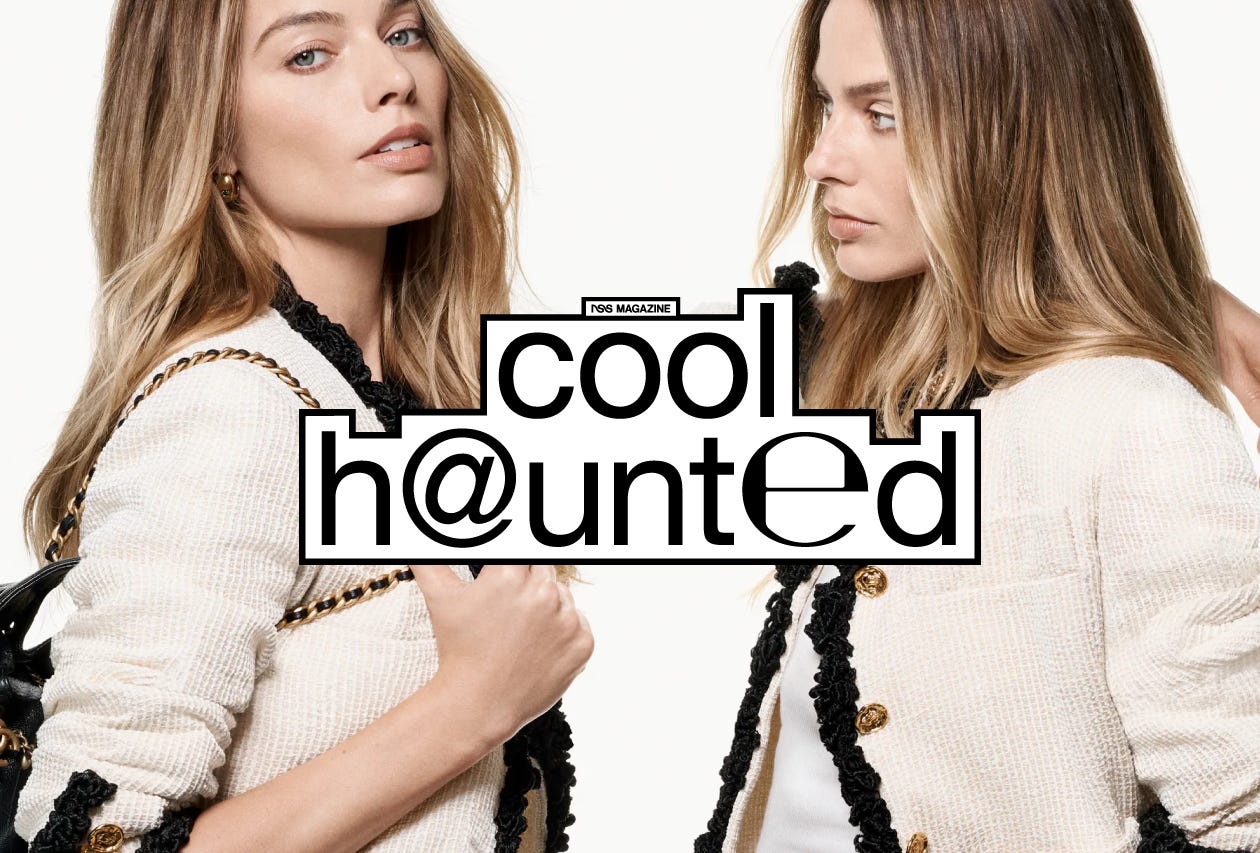
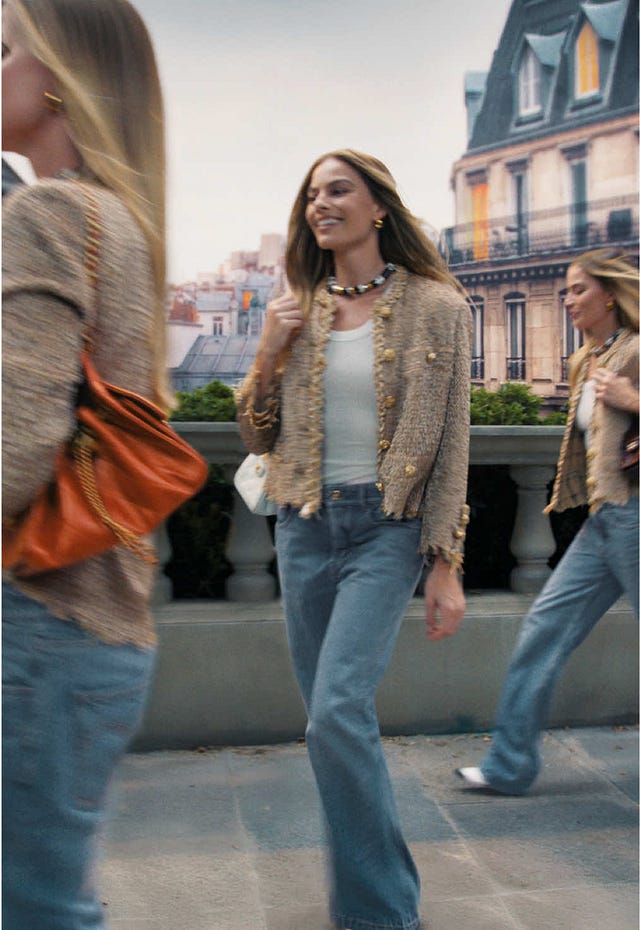
Chanel has just launched a new campaign directed by Michel Gondry for the CHANEL 25 bag, starring Margot Robbie. The actress from Wuthering Heights meets all the versions of herself on the street, each wearing a different iteration of the French maison’s new bag.
Recently, the theme of clones, especially digital ones, has returned multiple times in fashion: just think of Prada’s Ritual Identities campaign for the Galleria bag, directed by Yorgos Lanthimos and starring Scarlett Johansson, or H&M’s advertisement from last March featuring 33 pairs of “digital twins” created with AI. In all three cases, the common denominator is the clone. Each project tells in its own way not only a different aspect of fashion, but also of the times we are living in.

 Tiktok failed to load.
Enable 3rd party cookies or use another browser
Twenty years after the release of the music video for Come Into My World, French director Michel Gondry returns behind the camera to present all the versions of Margot Robbie, each with a different CHANEL 25. As a tribute to the 2002 video, singer Kylie Minogue even makes an appearance in the video, on a set that recalls a Parisian neighborhood.
One might infer that the connotation of the song’s title, together with the choice of Margot Robbie as the protagonist, represents an invitation from Chanel into the new imaginary of Matthieu Blazy. In this sense, the clone device represents two values: the plurality of the Chanel woman imagined by the maison’s new creative director, combined with a surrealist cue that does not hide but rather enhances the sense of technological artifice, bordering on surrealism.
In Ritual Identities, Scarlett Johansson, who already starred in Jonathan Glazer’s 2024 short film, returns to act for Prada, this time directed by Yorgos Lanthimos. From the creative encounter between muse and creator emerges a sort of microcosm in the form of a feature film: Scarlett Johansson performs complex and mysterious rituals, unusual actions in archetypal settings of modern life and, during these processes, she duplicates and meets countless versions of herself. The film explores the concept of fluidity of personality, starting from the actress and then shifting the focus onto Prada.
In this context, the Galleria bag embodies and replaces reality just like a clone, making us think that the focus of the campaign is on Scarlett Johansson and Yorgos Lanthimos, when in truth the real protagonist is the bag itself. Prada, a brand that has always made intellectual collaborations its strength, stages the different identities of the contemporary woman as interpreted by Johansson, reproducing a theater of the everyday in which we all vent, through objects, small neuroses or peculiar gestures that tend to define us as human beings.


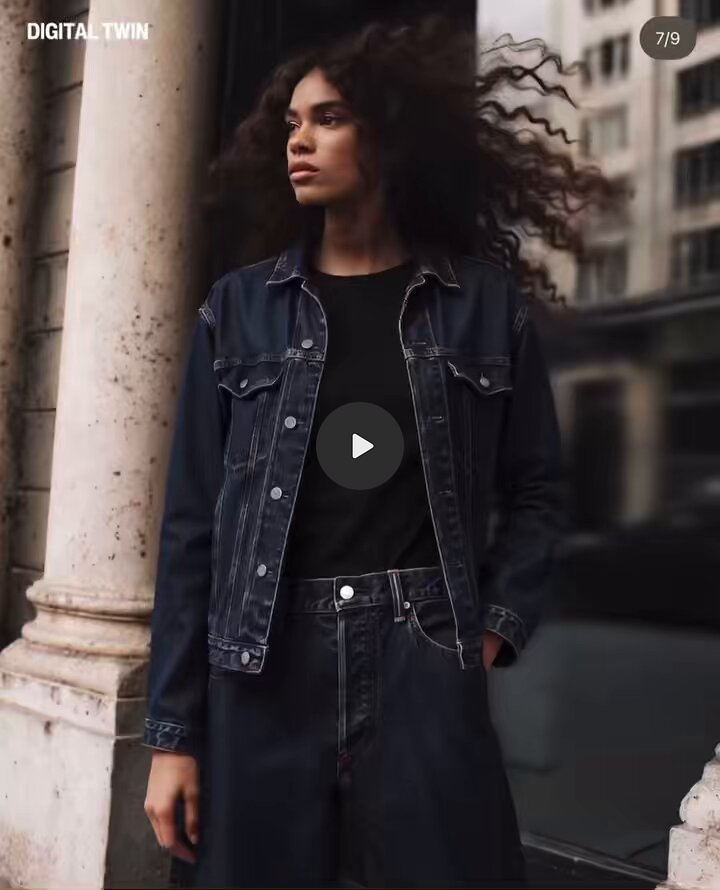
The theme of duality and the clone made headlines again last year with a controversial H&M campaign. Starting from the digital scanning of real models’ bodies, the brand created 33 pairs of “digital twins” to replace the “real” ones in the new advertising images. As we might have expected, the project sparked criticism and controversy among both industry professionals and the public, demonstrating how the use of new technologies in fashion remains a sensitive issue.
It is ironic that a reflection on the copy, albeit unintentionally, emerges from an H&M campaign, whose products are often “dupes” of luxury brand items: a short circuit that almost turns AI into a trap, worsening its position as a brand associated with lower-quality copies. Moreover, all this happens at a time when the creative industry is experiencing a certain anxiety about AI, seen as something that could become more performant than humans, even replacing them.
The campaign seems to address this tension lightly, playing on a duality that does not truly put digital and real in conflict, but rather creates complicity: the models joke about having “digital twins”. At the same time, it does not dwell on the deeper issues: can Digital Twins be paid? What is the point of the model figure if she is duplicated or replaced? Is it just a matter of cost-saving or is there something more? The campaign, similar to those created with AI by other mass-market brands, has helped make artificial intelligence not only an ethical issue, but also a legal one: New York’s Fashion Workers Act, which protects models from mistreatment and abuse, now also includes protection from the use of AI.


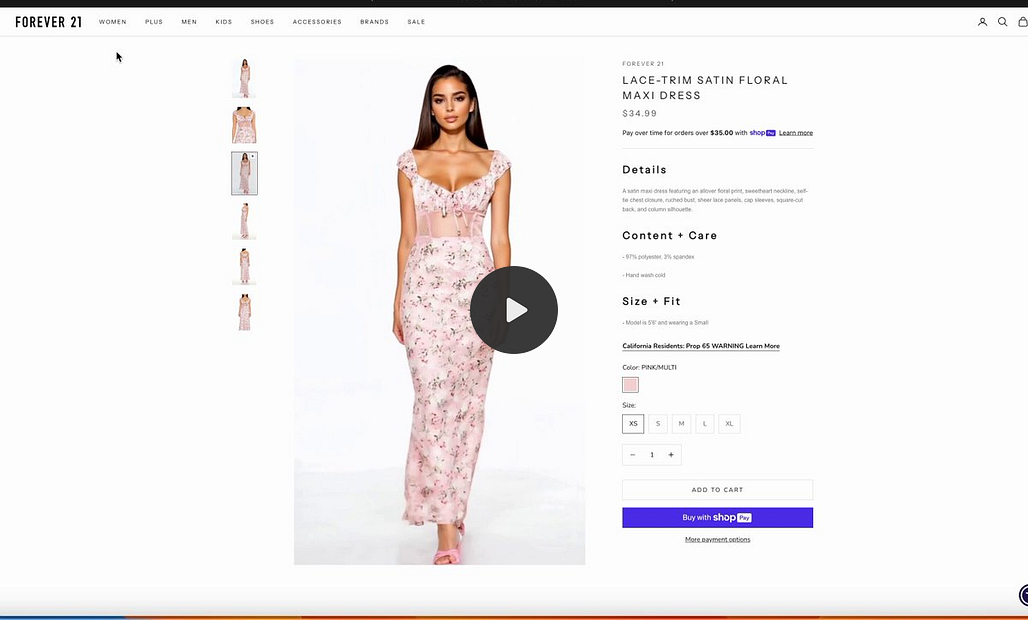
In a period in which AI has invaded our lives, it makes us question everything we see, from advertisements to the news itself. In response, brands leverage humanity (Prada’s intellectuality, Margot Robbie’s insistence for Chanel, the real-yet-fake models for H&M) to appear credible. Even though, in reality, all three brands have made use of new technologies, AI or not.
Multiplying Margot Robbie, one of the most beloved actresses of the moment, whose very presence - as in Greta Gerwig’s film Barbie - already takes a stance on a complex socio-political context, means reaffirming a precise intent. Reproducing her once, twice, three, five times is not a simple visual device, but a conceptual gesture: Chanel, like many other brands, seems to want to talk about authenticity through contemporary technologies, suggesting that what sells today is precisely authenticity - or, more precisely, its construction.
After all, every day we ourselves are responsible for producing copies of ourselves: continuous adaptations that allow us to adapt to everyday contexts. This is where the discourse becomes even more interesting, at the point where advertising and identity both converge in the same tension toward authenticity. Because, ultimately, a copy is nothing more than a reiterated concept, which finds its affirmation in repetition, or, in the most distracted cases, its dissipation in the multitude.