


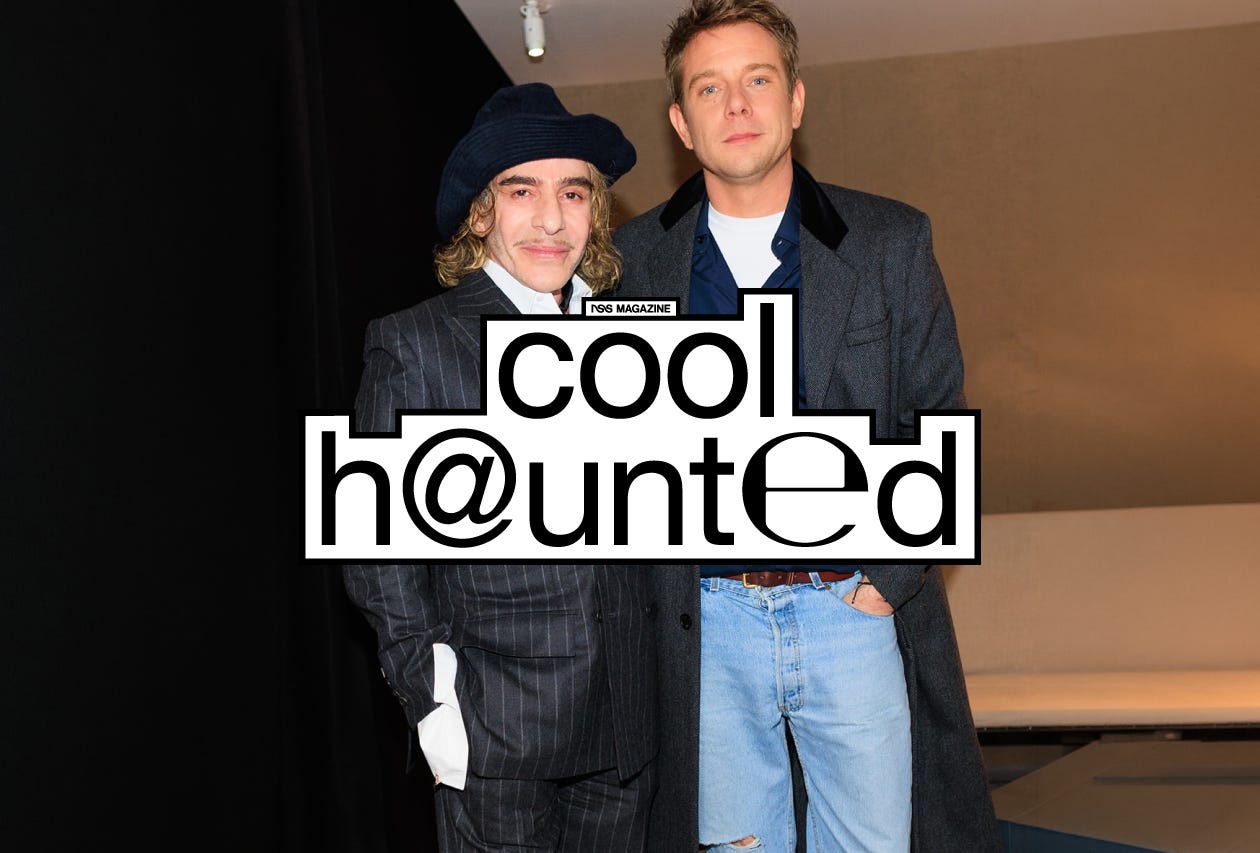
There is an ever-growing difference between the designers of the past and today’s creative directors. Whereas in the past, only the most outward aspects of figures such as Yves Saint Laurent or Valentino were known, the designers who now lead major Maisons live much more public lives. A new trend that has emerged in recent years is to reconstruct not only the private lives of these celebrity designers, but also to build their myth from the very beginning.
And while in the past a designer’s success seemed more immediate (after this or that relatively low-profile job, they would found a brand and achieve fame almost immediately), today the mechanisms of the industry are better understood. Just think of the backstage photos that are so frequently published during and after a show at Fashion Week, something that decades ago would only happen on very special occasions. But understanding the evolution of the designer myth or of the way we perceive it also means understanding the evolution of fashion and the way it is woven into contemporary culture.

In the past, the term designer was on the same level as painter, author, or artist. Today, however, we have to settle for the title of creative director, at most an artistic one. The term reflects the generational shift that took place around the 1990s and early 2000s, during which the founders of the Maisons were succeeded by other designers who worked under them.
The difference between the two terms implies a subtle evolution of roles: the designer was once conceived as a creative genius who, shut away in their atelier, created beautiful clothes and collections. Their personal identity corresponded to that of the brand and, even if they had entire ateliers at their disposal, it was almost as if every look that walked the runway came directly from their own hands.
Today this illusion has partly faded: we know that entire teams of designers work on every product category within a much more corporate structure. The role of the creative director has become diluted because it has expanded, moving from individual creators to companies distributed around the world, with the addition of the CEO role and an army of other professional figures. By now, in our disillusionment, we also know that there is another designer, namely the merchandiser, who redesigns what has appeared on the runway to make it producible at scale and sellable in stores.
While this transformation was taking place in ateliers around the world, it also happened that brands and creative directors multiplied exponentially. Today there are countless brands to follow during Fashion Week in New York, London, Milan, Paris (as well as Copenhagen, Madrid, Tokyo, Seoul, and so on). For this reason, it became necessary to make creative directors recognizable figures through social media, interviews, front-page features, scoops and, ultimately, guides tracing designers’ moves from one brand to another.

In 2010–2011, two serious incidents shattered the myth of the designer. The first concerns the now-famous outburst by John Galliano at La Perle in Paris, which forced the entire world to publicly acknowledge that the mythological creative directors were considerably more problematic figures than everyone liked to believe. Lee McQueen’s suicide the following year further revealed that the glittering world of fashion could be far less glamorous than people believed.
But the real moment when we became interested in the genealogy of designers came with the phenomenon of Virgil Abloh and the various designers who came from Kanye West’s Donda Academy. Suddenly, a cluster of new brands had appeared, innovative and youthful, but above all detached from the game of the major Maisons. Their cross-disciplinary talent was embedded in a new way of working, in a new concept of dialogue and transparency with the community. Suddenly, fashion could be a hoodie, and it was the same one the creative director wore at the end of the show.
After lockdown, with Abloh’s passing and the beginning of the great creative carousel that would define the following years, this modus operandi also reached the upper echelons of the industry. When Daniel Lee arrived at Bottega Veneta, many compared his work to that of Phoebe Philo, with whom the designer had worked. When Sabato De Sarno arrived at Gucci, the public discovered the existence of the Design Director and, perhaps for the first time in the history of the industry, a short film was created literally titled Who is Sabato De Sarno?
With the arrival and success of Matthieu Blazy at Bottega Veneta, a new type of storytelling emerged. To convey the extent of his talent, people began telling the story of his past for those who did not already know it: he too was a former collaborator of Phoebe Philo, and later the gray eminence behind the famous FW13 of Maison Margiela. From there, fashion began trying to establish which creative director of today had worked with which creative director of yesterday.
This genealogy obsession now serves a dual function. On the one hand, it serves to justify the status of these new names as creative authorities and the value of their products themselves: demonstrating that a designer “comes from” something, that they have passed through a school, an atelier, a hierarchy of apprenticeship, has become a way of legitimizing their authority. On the other hand, this same genealogy makes it possible to construct genuine elective affinities, almost like families or creative clans: the emblematic case is that of Phoebe Philo’s “ex-alumni,” an informal group of designers who are recognized precisely by virtue of a shared formative experience, and for whom having worked under a designer considered so essential represents, in itself, a public validation of their talent.
Meanwhile, the fashion audience is more informed about the mechanisms of the back office, while social media has led these same designers to become known in their own right. And also through a process of identification, given how difficult it is to find work in this industry, we have perhaps become interested in knowing how these people who were so important became so important. Photos of young Matthieu Blazy and Michael Rider, taken before they were famous, began surfacing online, offering the ever-useful and sentimental hook of “They were just like us.” Finally, it cannot be ruled out that the brands themselves have fueled this phenomenon in order to turn creative directors into celebrities.
It has also happened that, without becoming creative directors themselves, certain Design Directors have become celebrities in their own right thanks to Instagram: this is the case of Thibo Denis, who emerged during his years at Dior and, now at Louis Vuitton, is almost a niche star among industry insiders. Or Edouard de Weissenbruch, menswear designer at the “new” Celine, who in just a few months has become a true reference point thanks to social media. In this case, however, we see the mechanism come full circle: if the designer of the past, remote and sublime, could not survive the social media era, the designer of the present thrives thanks to it and reconstructs the same myth with the same building blocks, but within a completely different framework.