




At the end of 2017, Alphabet — in other words, Google — had a market capitalization of around $730 billion. LVMH was worth $147 billion and Kering, which at the time still included Puma through the Artemis fund, $159 billion. Combined, the two companies that sell desire were worth 28% of the company that sells the order in which search results appear. Flash forward to the end of last July: Alphabet is worth around $4.2 trillion. LVMH is worth €234 billion and Kering €35 billion, or just over $300 billion combined. 7.5%. Publicly listed French luxury has gone from being worth just over a quarter of Google to one thirteenth in nine years. So is it really luxury?
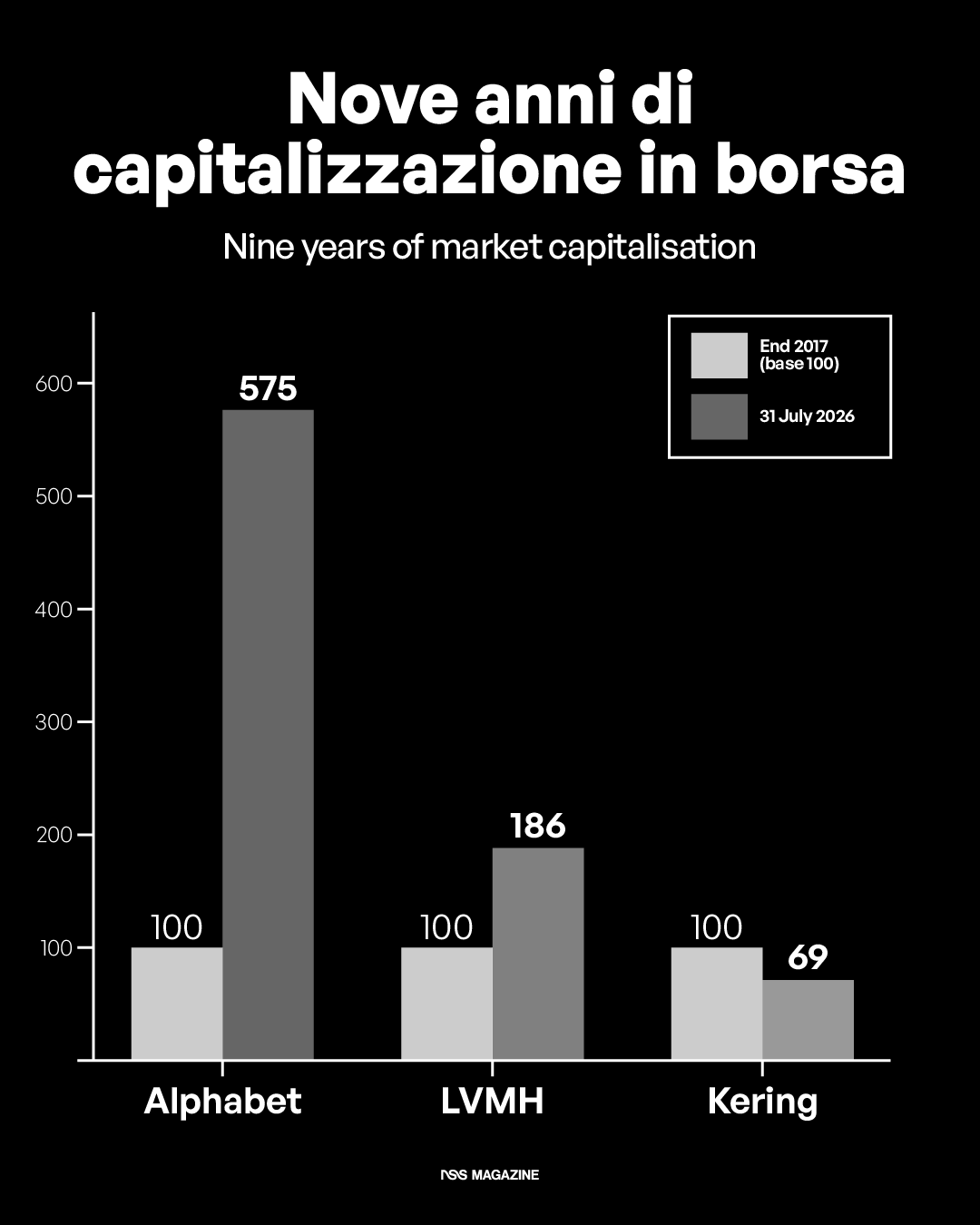
One number deserves to be singled out because it needs to be read twice. Kering today is worth less in dollars than it was at the end of 2017, when Puma was still part of the group. In nine years, it has divested Puma, acquired 30% of Valentino, built a billion-euro eyewear business from scratch and raised prices by roughly 15%. The net result of all that work is less than zero. Meanwhile, Google has created €3 trillion in value, eleven times the combined value of LVMH and Kering. And it did so without warehouses, creative directors or unsold inventory, but with a simple index that updates itself every night, for free, and has never depreciated by a single cent. Luxury has spent nine years explaining that value comes from scarcity. Meanwhile, value went where there was neither scarcity nor even a product. The point, though, is that the money did not evaporate: it changed hands. But whose hands?
The latest half-year reports from the two groups are honest: they contain no lies, they are certified by people paid not to trust anyone, and each runs to more than a hundred pages. They contain plenty of data and reassuring-sounding numbers, but they do not contain the number of garments produced, sold and left unsold; nor average prices, nor the millions of units written off.
It is an entire exercise in euphemism that, in the best Orwellian tradition, relies on a vocabulary designed to manipulate the narrative and blur certain uncomfortable truths. The term “normalization,” for example, means a return to reality, presented as though reality itself were the anomaly. “Positioning elevation” means that groups raised prices by 150% in the wake of Covid and sold far less, keeping revenues high enough for it to be called a strategy while also devastating Italy’s manufacturing ecosystem. Then there is the “aspirational customer”: the vast majority of consumers who live on limited means, cannot really afford luxury and who, at a certain point, simply stopped buying.
Other terms? “Inventory discipline” means markdowns and write-downs. “Network rationalization” means closures. “Distribution ecosystem” refers to outlets. “Creative renewal” means: “we have changed creative director for the third time in five years and this time it will work — at least in the outlet.” Meanwhile, “resilient” means the business is doing badly, but not badly enough to have to write it down explicitly. Things are worse for the smaller brands, reduced to fractions and administrative subdivisions, which lately have started being sold off.
None of these expressions is false, and that is exactly the point. The perfect omission does not lie. It replaces a number with an adjective and relies on nobody asking uncomfortable questions. Let’s call it an “Omissey”: not an omission, which would imply fault, but a long journey through a series of perfectly legal absences, at the end of which the reader returns home convinced they have understood everything.
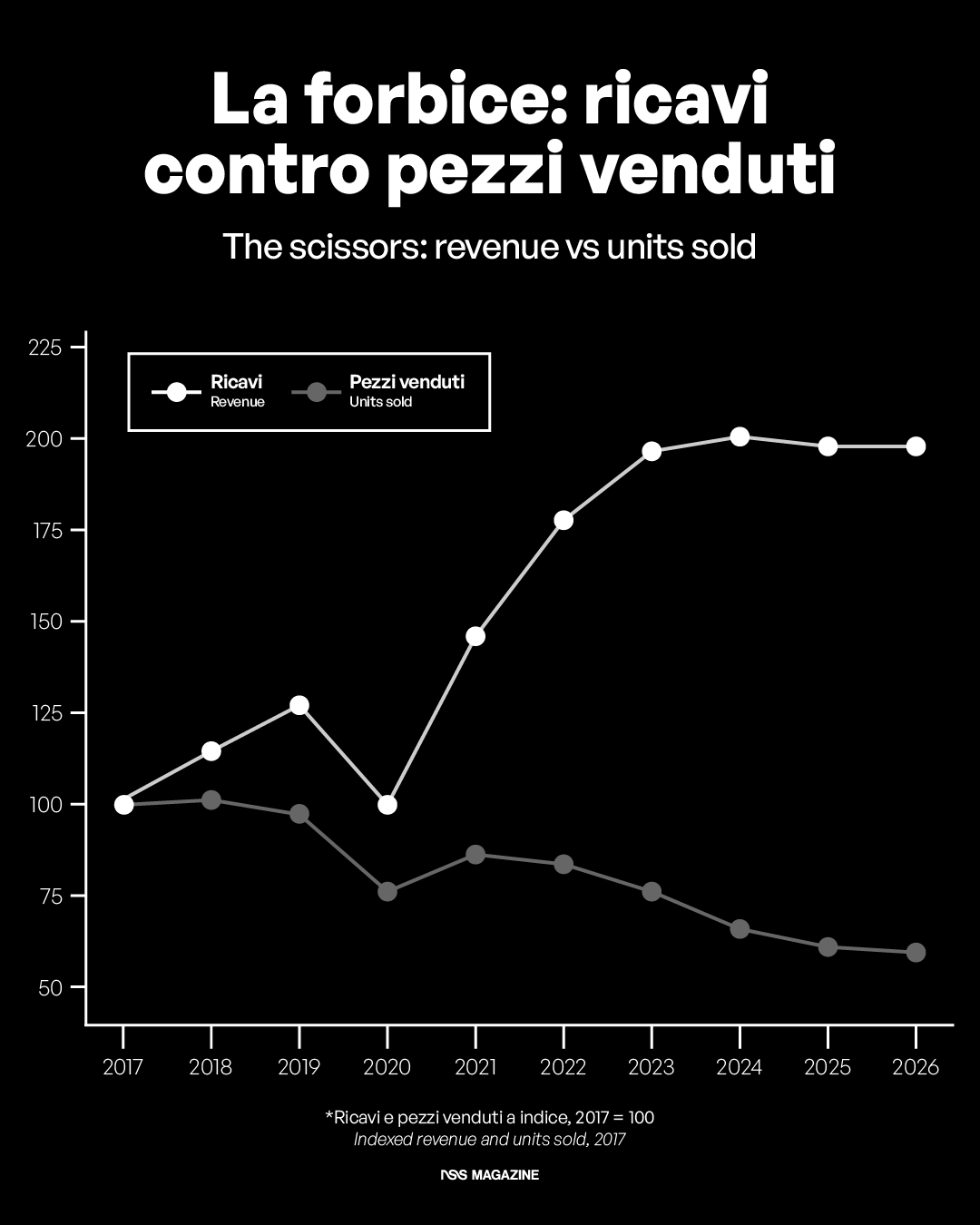
Here, then, is the thing neither half-year report says, not because saying it is forbidden, but because there is no line item where it lands. Fashion division revenues doubled between 2017 and 2026. Units sold fell by around 40%. Nine years of growth came entirely from price increases applied to a shrinking customer base. That means 29 million units a year no longer leave the stores, as if one of the two companies had shut down its fashion division without telling anyone.
The stock market understood it before the financial statements did, as usual, and withdrew the premium. It did not so much stop believing in luxury as it stopped believing in luxury’s scalability, which is far more serious, because scalability was the only reason a handbag company could ever be worth as much as a software company.
On July 29, the point became visible to the naked eye. In the same trading session, Hermès — the company that does everything right in luxury — lost 11%, while Kering gained 16.9% because Gucci had fallen by 2% instead of 8%. The market punished the company that grew less than expected and rewarded the one that fell more slowly than expected. Neither reaction had anything to do with a garment. Nobody tells us who bought those Kering shares. Nobody tells us who is actually making money.
Twenty-nine million is a number, and numbers have the unfortunate habit of looking like answers. This one is actually a question: were they customers? Because a unit sold and a customer are not the same thing, nor have they ever been. In 2017, a garment could leave a maison’s books in five different ways, and only one of them required someone to actually want it and pay full price for it.
It could be sold directly to a customer. It could be invoiced to a multi-brand retailer, which was itself a customer: even if the item remained unsold and was later heavily discounted, on the maison’s books it remained a unit sold at full wholesale price. It could pass through an outlet, which appears in the accounts as a retail sale just like any other. It could end up with a stockist, which appears in no presentation and absorbs whatever the other channels failed to absorb. Or it could be bought on Via Montenapoleone by a daigou who purchased ten units to resell in Shanghai: in the systems, those were ten sales; in reality, it was one person with a very large suitcase.
The real question is not how many units we lost. It is how many of those units, even in 2017, represented something other than a genuine direct sale. We do not know because there is no line item where that figure is explicitly disclosed. We can, however, set three benchmarks, and each tells a different story.
If every lost unit corresponded to a customer who bought twice a year, the number of lost customers would be 14.5 million. Out of a customer pool that industry presentations estimate at 400 million people, that is 3.5%. Which is already remarkable in itself: losing three customers out of every hundred cost these two companies a third of their market capitalization. It is not credible. A couple of generations of consumers have disappeared here. It is as if Apple had lost €16 billion in revenue over ten years. The luxury industry, dependent on China, no longer knows how to capture new customers.
If, on the other hand, the loss were concentrated among aspirational consumers — those who buy one item every two years and were the first to stop when the cost of money doubled — the figure would be almost 60 million people. Fifteen percent of the declared customer base, gone in nine years without a single press release ever recording it. In fact, financial statements would do well to show negative figures clearly: they would be far more revealing.
Finally, if most of those 29 million units were never really customers but channels, then far fewer customers have disappeared. That is the comforting version, which is precisely why it deserves closer scrutiny. But channels are hybrid and very often off-price. Which means that if a significant share of the units sold in 2017 did not end up with customers but with channels, then the starting base was inflated. Not false in the strict sense, merely quantitatively distorted.
And if the base was inflated, then so were the industrial plans built on that growth, the production capacity sized around those volumes, the store openings decided on those projections and the prices raised by 150% in the belief that demand would hold. There is no good version of this answer. Either 14 million real customers disappeared, or there were never that many of them in the first place.

Let’s start with who did not pay, because that is the shorter list. Neither controlling shareholder paid: they lost wealth, not power. Nor did the executives who set the prices, devised the 2021 expansion plans and then the 2025 closure plans: almost all of them left with multimillion-euro severance packages, the only line item in the luxury industry never to have experienced destocking. Nor did the analysts, who are already selling studies on how to get out of the crisis they had previously predicted would never happen.
Now to everyone else, in ascending order of how little they were consulted. Most of the value destroyed sat in index funds, meaning the retirement savings of people who have never bought a luxury handbag. They financed the opening of a flagship on a street they will never see and paid for its closure four years later. In the industry’s narrative, the shareholder is an abstract and vaguely irritating entity. In reality, it is almost always someone who needs to retire.
Then there is manufacturing. Across Tuscany, Marche and Veneto are the workshops that physically produce what the two groups call craftsmanship. When demand falls by 40%, almost all of that decline is passed down to the link in the chain without a multi-year contract. In 2026, Kering’s Italian factories saw strike participation rates of between 70% and 100%, figures Italian manufacturing had not seen in decades. A clear indication of what is happening to Made in Italy.
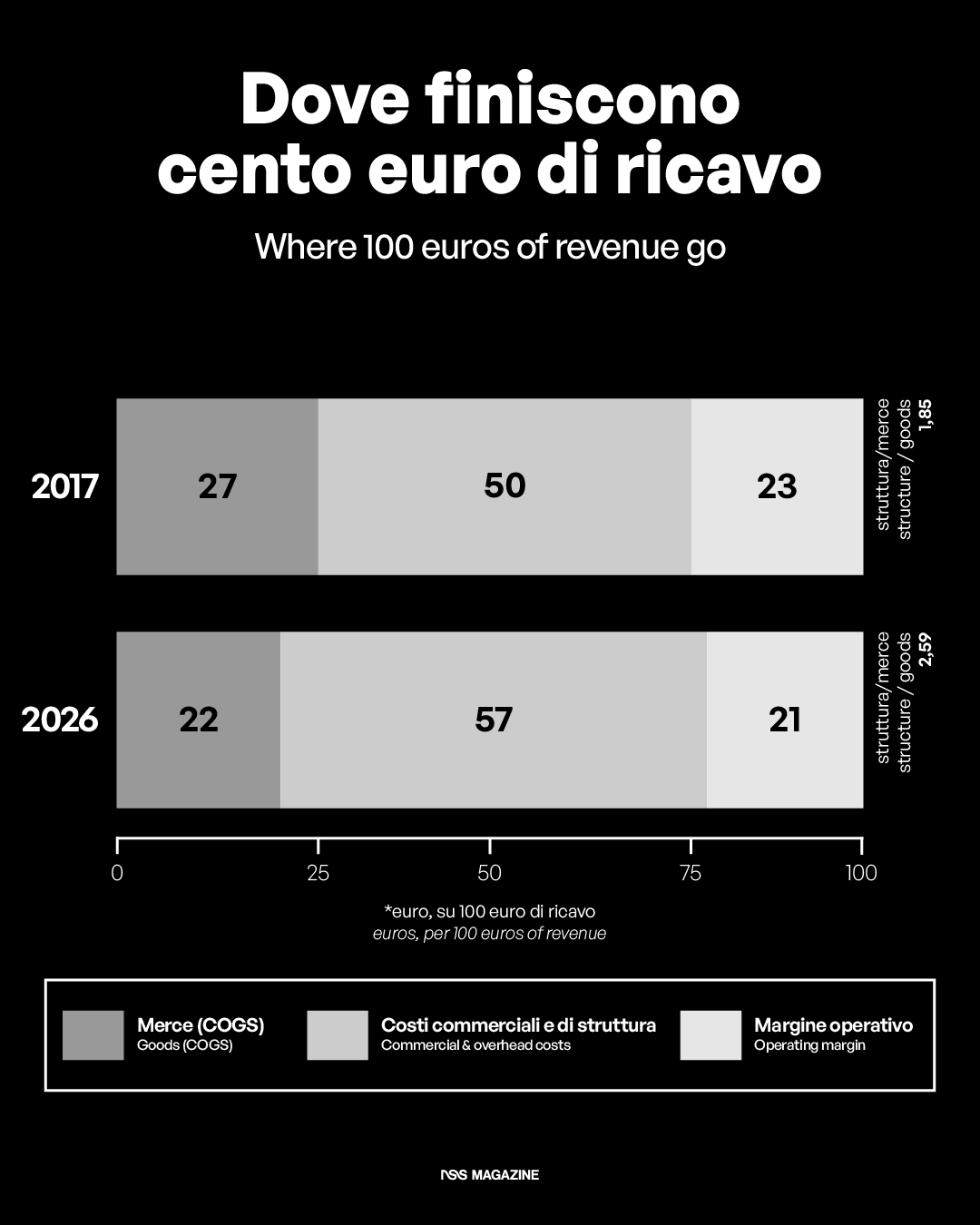
Then there are the sales associates. The cost structure per unit sold is virtually identical for the two groups: €392 versus €383. That includes rent, visual merchandising, fit-out depreciation and in-store sales staff. When volumes decline, three of those four costs are contractually fixed for years. The fourth — the sales staff — comes with thirty days’ notice. And selling costs more than producing.
Another category hit is multi-brand retailers. Between 2000 and 2020, fashion moved from wholesale to direct retail, telling its long-standing clients that it was a matter of controlling the brand image. The real intention, however, was to capture the retailer’s margin while also taking on its cost structure — a bet that worked only on the condition that volumes kept growing. When they stopped growing, the multi-brand retailer that could have absorbed part of the risk was no longer there, because the brands had shut it out while explaining that it was for its own good.
Then there is the customer, who paid twice: first at retail, 150% more than in 2017 for iconic leather goods; then again when they discovered, on any resale platform, that the product was actually worth a third of that. Neither the press nor a financial statement explained it to them. The secondary market did, publishing the effective value of every reference every day and becoming, in practice, the only transparency mechanism this industry has ever had. Nobody designed it, which is probably why it works so well.
And finally there is the trade press, which surrendered to flattery, rigged interviews and clueless influencers. It burned through a new generation of talent, using them as cushions for unscrupulous PR departments. Most importantly, it lost all bite and critical instinct. Fabrizio Romano has a firmer grip on reality than Business of Fashion.

We will read that the sector is resilient. That local customers are showing signs of selective recovery. That positioning elevation is proceeding as planned and that the second half will benefit from a more favorable comparison base — again, we are below 2017 — which is an elegant way of saying that last year was so bad that this year it does not take much to look better.
We will not read how many garments are sitting in warehouses, because companies are not required to disclose it. And they are not required to disclose it because the perimeter of financial reporting was designed for an industry that sold machine tools and is now being applied to an industry that sells perishable desire. The problem could be solved in ten lines, using data from systems that already update those figures every night, because otherwise nobody would know what to ship to stores on Monday morning: units produced, units sold at full price, units sold at a discount, units in inventory, average realized price.
It will not happen, and the reason is that the average realized price is not merely a data point: it is the business model. It is the distance between what the customer believes they are buying and what the company actually collects, and it is on that distance that brand value rests. It is like asking the innkeeper to print on the label exactly how much water he added to the wine. Technically simple, commercially inconceivable. Less luxury, more minestrone.
There is, however, one detail that brings the whole thing full circle. Knowing how many people actually buy is precisely what vertical integration was supposed to solve: it is the argument this industry used to shut out thousands of multi-brand retailers, spend tens of billions on directly operated stores, and build CRMs, apps, clienteling systems and customer-recognition tools at checkout. They have the data, but it appears nowhere. Twenty-five years and tens of billions invested to acquire one piece of information, which happens to be the only one that is never published. The data is not missing. The willingness is. Above all, what is missing is the courage to understand that a crisis can only be solved through a revolution.
The latest major luxury studies from Altagamma tell us to move towards experiences, hospitality and fine dining. In practice, they are telling us to abandon ship and climb into the lifeboats. Ultimately, LVMH and Kering will have to study the path taken by Volkswagen, Porsche, Audi and BMW. They are sitting there waiting for the Chinese, after consuming them, to eventually eat them outright.
Then, unexpectedly, the moment for extreme cuts will arrive: first the designers, then the managers, then the stores, then entire departments. But it was all written already. A few got rich; many lost their way. Returning to fundamentals would mean talking less and working more. The long Arctic night has only just begun. The dinosaurs will disappear, but who will rise again?
That is why financial statements should never be read for what they say, but for what they leave unsaid.