



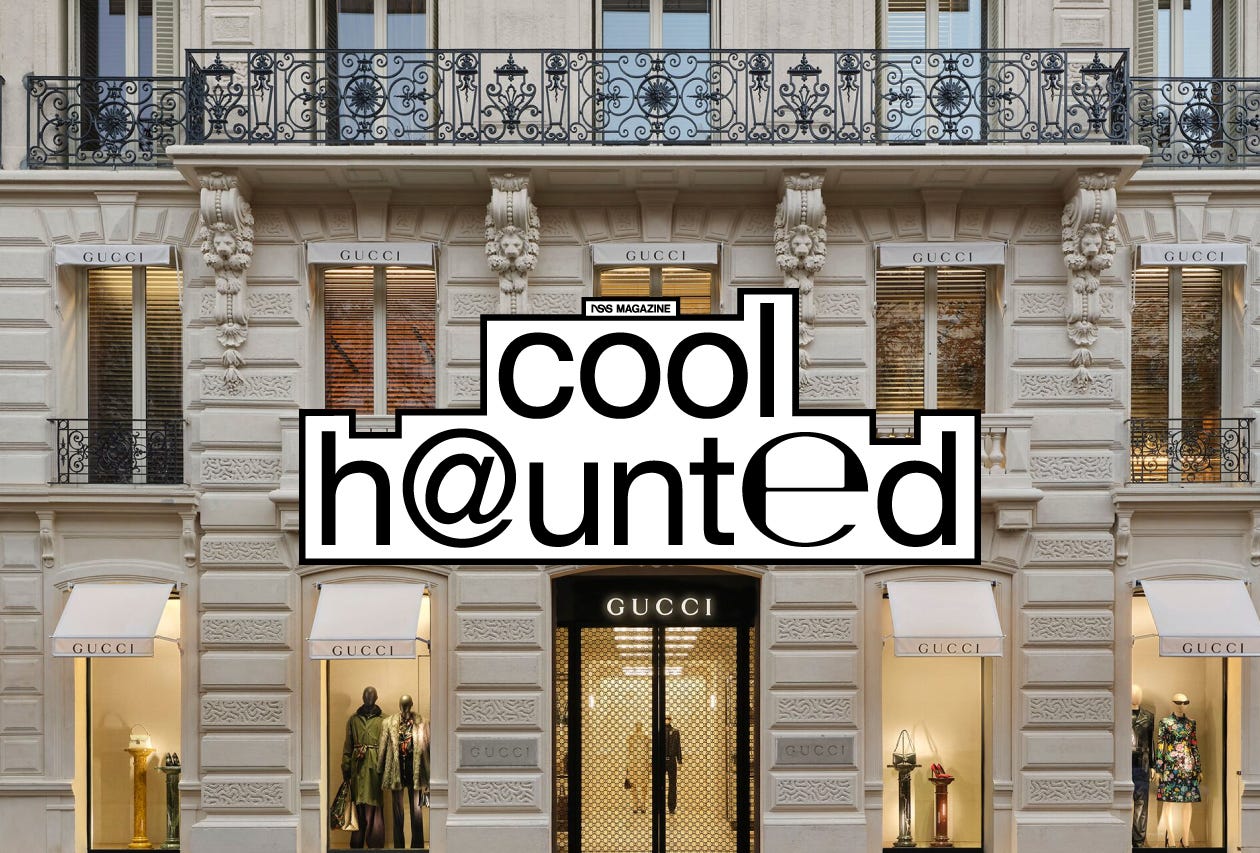
“Everything we create at Gucci comes to life in our stores,” Francesca Bellettini told MF Fashion about the new Gucci mega-boutique on Avenue Montaigne. “This is where the maison expresses itself in its entirety, and this is where the relationship with our clients is born and grows. That is why investing in them is a strategic priority.“ A statement that might seem like a formality, yet it speaks to the heightened sense of importance that brands’ physical retail locations have taken on in the age of the luxury crisis. Like arks in a flood, the stores of large and small brands alike have increasingly become a form of market presence of existential importance in an era where marketing alone is no longer enough. But why?
Back in 2023, with LVMH’s enormous investments in both the Dior store on Avenue Montaigne and the Tiffany & Co. store in New York (continued also at the Milan location), we had the opportunity to discuss mega-boutiques: retail spaces as grand as cathedrals, incorporating museums, restaurants and cafés, areas dedicated to VICs, and artistic installations. Spaces that, in short, were meant to become destinations to visit and linger in. Over the years, the formula has solidified and spread to brands outside the luxury segment, but a new element has emerged: these stores can help weather the crisis. Or so one hopes.
As Forbes explained at the start of the year, luxury e-commerce has stabilised at between 20% and 25% of the market and appears to have hit a ceiling on growth. Physical retail therefore accounts for the remaining 75–80% of a luxury sector increasingly dominated by a small number of extremely wealthy clients who want to visit stores in person and feel engaged and “part of the family.” After an era of online decentralisation, cross-sector forays into culture and art, and heavy investment in intangible media value, the industry seems to have rediscovered its founding principle, rooted in the equation “foot traffic = sales.” And the effects have been visible in the multiplication of efforts and investments in this direction. But how exactly has the role of stores changed?

With an ever-narrower and ever-wealthier client base, as noted, stores are increasingly the only places where brands can generate their millions. Even in industry communications, the narrative of a brand’s progress and expansion is more and more tied to new store openings. These are experiences being offered, signals of hope in the new market, draws for local communities, and privileged points of access where merchandise can be examined up close. This year’s Blazy-mania, which had people queuing outside Chanel to try on shoes and accessories, played out primarily in stores. The narrative it generated was built on the wonder of seeing people return to shopping in real life.
Alo Yoga’s entry into China, too, was anchored by a first pop-up in Shanghai and a flagship in Hong Kong, celebrated with a monumental drone show over the city’s skyline, while another store opened in Berlin. The return of Yeezy with a show in Los Angeles, meanwhile, will coincide with the opening of the brand’s first flagship, where the event will be held. The openings of Prada Galleria in Milan and the Moncler store on Fifth Avenue have become full-blown brand jubilees of activations. To signal Tom Ford’s expansion in America, the announcement is simply that the brand has opened three new stores.
But the logic of the store as an outpost, almost a flag planted to mark a brand’s advance into a given market, applies across all market levels: Lacoste with its café in Seoul, Moynat landing on Montenapoleone, Ulla Johnson and DeMellier arriving in London, Borsalino doing the same in Paris. To signal the start of a new phase of global expansion, Sandro Paris has publicised the renovation of its stores, with the new concept set to be rolled out across its other locations worldwide. Massimo Dutti has done the same at a different market level, with plans to open seven new stores to add to its fleet of 500 points of sale around the world. It is like a game of Risk: there are no nations, only markets.
A retail concept can serve many functions, though. After three years with a “trial” pop-up, Hermès opened a permanent store in Williamsburg. Loro Piana, meanwhile, also in New York, opened an atelier on Madison Avenue for made-to-measure services and to “educate” clients on materials and craftsmanship. In a perhaps more innovative way, Zegna has transformed its summer shows into destination shows in ever-new cities where, at the same time, it brings the Villa Zegna concept: a temporary atelier where you can order pieces fresh off the runway, have suits made to measure, and buy exclusive products. The latest was in Los Angeles, the next will be in Beijing. A need to keep engagement high with a sense of urgency and occasion that explains why these new-generation mega-boutiques include spaces dedicated to a full calendar of events.
It doesn’t only concern luxury, as we were saying. Already last year, talking about the flowering of the “new streetwear” such as Nude Project, Scuffers, Les Deux or TwoJeys, the founders of the brands themselves spoke of retail presence in the market as the epicenter of the brand’s local life. Something that has become necessary in an era populated by brands that exist only on Instagram (think of the Belgian Anovair or Roman Pell, who has only four stockists in the world) and from which buying is a bit of a lottery. Needless to say, having to look up a brand on Trustpilot before making a purchase is not a particularly dignified brand experience. On a purely perceptual level, then, a physical store marks a brand’s presence in a city in many ways. In Milan, for example, and especially among the very young, the sight of Cold Culture and Nude Project bags has become increasingly common on the streets.
The game, however, is evolving. Especially in luxury, new openings represent a kind of Monopoly: not only in the districts along Europe’s “luxury streets” is productivity calculated per square metre (the highest-yielding in Italy is Salizada San Moisè in Venice, even if rents on Montenapoleone are higher), but the opening of new stores around the world follows the trail of new wealth. Like mushrooms after rain, boutiques spring up in the wake of economic prosperity. According to Savills’ study America’s Expanding Luxury Map, brands like Hermès are “bringing luxury retail closer to affluent consumers, rather than relying exclusively on traditional gateway markets.”
Scottsdale, Arizona, the city that has seen the highest number of new millionaires in a single year, has quickly attracted Hermès, Loro Piana and Montblanc, along with other luxury hospitality services such as hotels, spas and restaurants. And this alongside the sustained performance of other luxury metropolises. WWD reports: “In 2025, North America accounted for 27% of luxury store openings, the largest share of any region, and for the first time ranked first since Savills began tracking activity in 2016. New York also reasserted itself as the world’s leading city for new luxury store openings, with activity up 23% compared to the previous year.“
The conquest of new spaces, the expansion of existing ones (Celine has today doubled the square footage of its Via Condotti boutique), and also the heavy investments made both in spaces dedicated to non-sales services and in staff training for clienteling now represent the primary investment focus for brands. Up until ten years ago, one might suppose, those funds were channelled into social activations, collaboration launches, and communications and marketing projects.
Today, collaborations are no longer talked about as much, because the point is no longer to attract new clients but to retain the ones already there: not coincidentally, this week BoF credited in-store sales associates with the ability to generate millions through their client networks. They, and not influencers, are the brand’s true interlocutors. It remains to be seen, however, whether in the months ahead brands’ physical presence will translate into actual sales.