


The current edition of Pitti Uomo 110, which is taking place these days, is dominated by foreign designers. Little or nothing emerges in the trade press about the 720 brands present, while there is constant talk of the super foreign guests, for several years now the true media draw of Pitti: from Simone Rocha to Sunflower, passing through Kei Ninomiya, Jiyong Kim and William Palmer. At a media level, it sounds more exciting that the Italian platform of Pitti attracts more or less famous foreign talents, precisely because they certify its global appeal and relevance. It is a shame, however, that the only Italian Guest Designers of recent editions have been just Niccolò Pasqualetti and Magliano, two rising stars of Italian fashion who, incidentally, normally present in Paris. We could call it, quoting the Sanremo Festival, “Super Guest Fever”: aren’t there local designers who would deserve their own show at Pitti?
Something similar is happening with the Milan men’s schedule. Besides the handful of historic brands that almost by necessity must present in the city, the real attractions of the next season bring American names: Thom Browne and Ralph Lauren. It is not a problem that these designers show in Milan, but it is a problem that their presence has become structurally necessary to bolster a fashion show calendar increasingly populated by names (many of them also foreign) that one has to Google to recognize. On the contrary, many emerging Italian designers have to settle for the presentation format.
The implicit message in this Italian foreignophilia is twofold: on one hand, the desire is to communicate openness and cosmopolitanism, but on the other, it implies that what is produced internally is not exciting enough to stand on its own. The problem is also the prevalence of presentations. While some luxury brands feel comfortable with them, including Loro Piana and Brunello Cucinelli, a new brand that needs to establish its own narrative requires the incisiveness of a real show. And both for reputational reasons and visibility, it would be much better if these designers could have a proper show on the calendar and not a mini-presentation for one day on the outskirts of the city. Something that elsewhere, especially in London and New York, has been understood.
 Tiktok failed to load.
Enable 3rd party cookies or use another browser
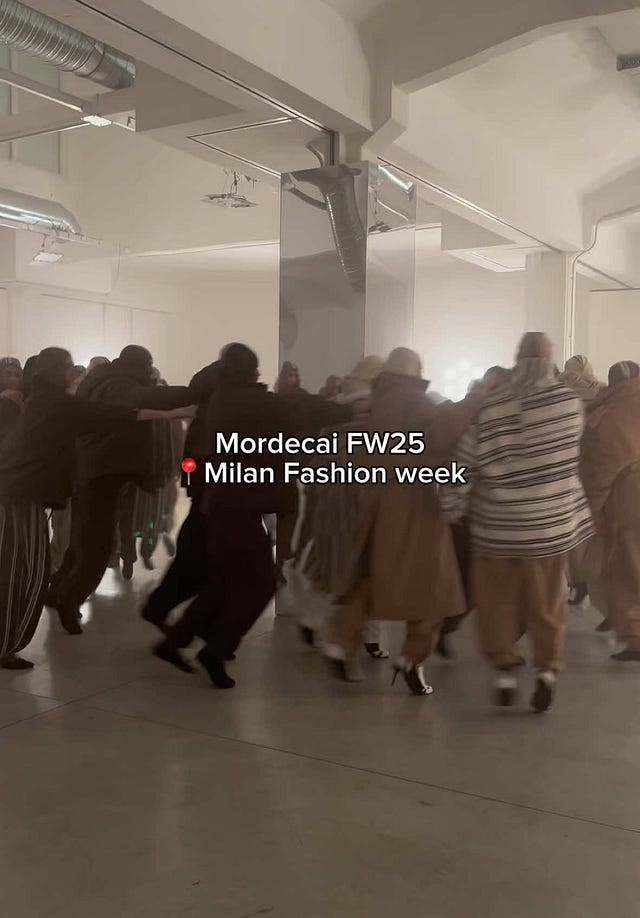
In Milan as in London and New York, numerous brands rely on the support of incubators that provide a shared show space for several brands. In recent years this has become the norm almost everywhere, also for reasons of efficiency. In Milan we have Fondazione Sozzani and Spazio Lineapelle, in New York there is Storied NYC which has hosted several shows in the context of NYFW Collections, in London there is the NewGen Space at 180 Strand.
A difference that is noticeable between abroad and Italy, however, is that both on the production side and on the media attention side (think for London of the shows by Tolu Coker and The Vxlley) emerging talents enjoy the same degree of consideration and polish as more established realities. In general, especially for Milan (and partly also for Pitti) young Italian designers face an urban and symbolic landscape that marginalizes them or confines them in boxes, categorizing them in the ancillary position of the promising newcomer.
Both for presentations and shows, they are often offered stages that are literally and metaphorically smaller and more makeshift, “limited enclosures” whose existence even the Vanessa Friedmans and Suzy Menkes of this world, as well as the big buyers, probably do not even suspect. In fact, hosting several shows in the same space (always a budget issue) tends to subtract something from a brand’s personality. Yet in America something is changing.

Since last September, a production company called N4XT Experiences has begun changing the way New York Fashion Week works. Instead of leaving every designer to find and pay for a space for their own show, the organization KFN was created to secure venues and cover their costs for selected brands. In the SS26 season, N4XT made available several types of spaces scattered across Manhattan, including proper venues for runway shows by the bigger brands, a shared space for smaller brands that could organize in turns, and showrooms for those who preferred to show the collection by appointment only.
The important thing is that N4XT took on the cost of the venue itself and all the logistical aspects: permits, backstage setup, makeup and hair equipment, lighting, and even catering. Designers were left to think only about things like PR, security, and models that is, the creative and organizational part of their show, without the economic burden of the space itself. This first phase was very successful, so much so that over a hundred participation requests arrived from brands, even if only a portion were actually accepted.
Given the positive feedback, for the February 2026 season N4XT decided to relaunch the project under a new name: NYFW Collections. Designers, selected once a year, can participate for free for two consecutive seasons, continuing to receive venues and logistical support without having to worry about space costs. For this new season, locations such as the New York Public Library and an expanded space for multiple designers together in the building that housed the Chelsea Factory were added, while the showroom headquarters remains at High Line Nine, with the area of activity concentrated between Hudson Yards and the Meatpacking District.
Instead of every brand searching for, renting, and paying for its own room independently, N4XT Experiences and KFN have made the right spaces available for free in different points of the city and handle all the practical behind-the-scenes work, leaving designers the freedom to focus on the collection. But above all, emerging brands are not placed in their own “kids’ area” but are inserted into the main flow of industry communication. Whether the location of a certain show is an abandoned warehouse or an old palace matters little, Margiela and McQueen worked miracles in condominium courtyards and old warehouses in sketchy, cheap areas. After all, any newcomer has to cut costs.



Looking at this model, it is natural to wonder why in Milan too the Municipality and the Camera Nazionale della Moda Italiana cannot move in a similar direction. Today it often happens that presentations and shows by emerging designers end up concentrating always in the same two or three addresses, perhaps for budget reasons or organizational convenience. But the result is a flattening effect that gives the fashion week a subdued, almost improvised air.
Seeing the same rooms, the same backdrops, the same photographed corners repeat season after season communicates a sense of narrowness and lack of care, as if the event did not have the economic and cultural strength to renew itself. If instead a “New York Model” were followed, making available, free of charge or at a nearly symbolic cost, a network of publicly or institutionally owned spaces, scattered in different areas of the city, the effect would be twofold. On one hand, it would remove from young designers the economic burden of finding and renting a location, leaving them the energy to focus on the collection and the staging, exactly as happens with the New York model.
On the other, it would finally give a jolt to the geography of Milan Fashion Week, bringing shows and presentations to neighborhoods that today remain on the margins of the official circuit: former industrial areas, historic courtyards, underused cultural spaces, peripheries that deserve more visibility. This would not only mean making the experience more interesting for buyers, editors and the public, who would discover new corners of the city instead of always circulating among the same blocks, but would also build a richer urban narrative, capable of portraying Milan as a city that renews itself and not as a city that repeats itself due to lack of resources or vision.