


Leggi l’articolo in italiano qui
It is well known the aphorism by Hegel according to which reading the newspaper is the modern man’s morning prayer. More precisely, it refers to a form of realistic prayer addressed, it is not entirely clear to whom, in the hope of giving shape and order, for at least one day, to the chaos of the world. We live in days in which the agents of chaos are hegemonic.
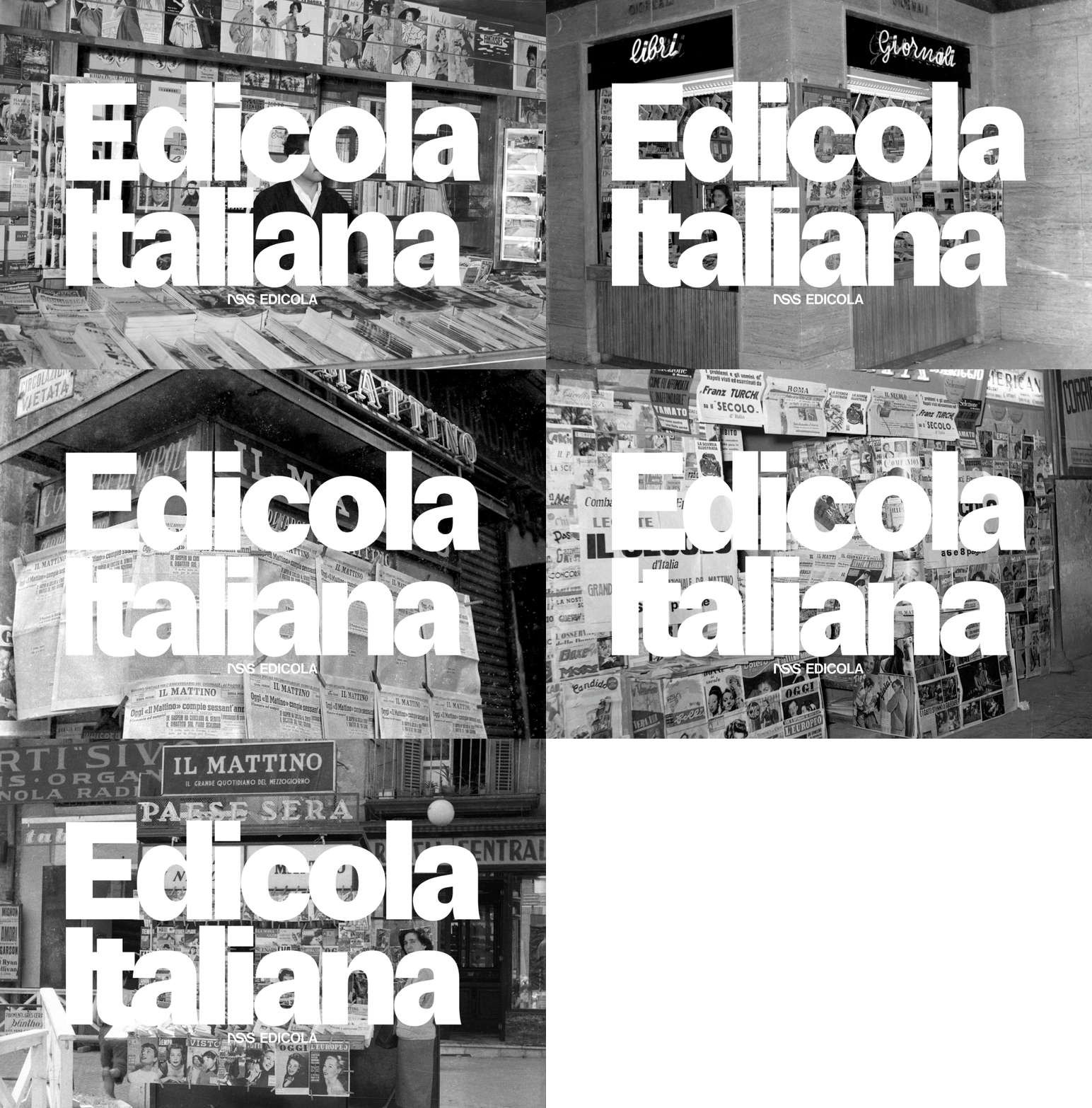
And to read newspapers and tame chaos, newsstands are needed to sell them. The newsstand [from Lat. aedicŭla “small temple”, diminutive of aedes “temple”].
According to Treccani, it is
1. a. A small temple or chapel with a statue inside, in the center. b. A small architectural structure, usually consisting of two columns topped by a pediment, often attached to a larger building, serving as ornament and protection for sacred images, commemorative representations, inscriptions, or niches and windows (aedicule niches, windows).
2. A structure made of iron, wood, or masonry, placed on a street or public square, in a station hall or elsewhere, intended for the sale of newspapers, magazines, and other publications.
For at least a century, the newsstand has been a perfect semiotic machine: a threshold. It was not a shop, because one did not really enter it; it was not a square, because one did not linger there for long. It was a liminal device, a boundary space, in which the citizen encountered the materialized form of the Encyclopedia — not the one contained in a volume, but the one in the collective mind of an interpreting community.
In front of the newsstand, every morning, a ritual negotiation of reality took place. The reader did not simply buy a newspaper: they bought a possible world among many competing worlds, each organized by a different regime of truth. The world described by Repubblica was very different from that described by Corriere, that of Manifesto from that described by Libero or La Verità, a paradoxical Italian version of the Soviet Pravda.
The nine-column headline did not simply say “this happened”, but “this deserves to be believed before anything else”. The newsstand was therefore the daily theatre of the struggle between interpretations, presented under the reassuring form of an ordered stack.
The newsagent performed a priestly function but not a dogmatic one: they guarded the temple without ever commenting on the orthodoxy of the faithful. They knew that whoever asked for the newspaper was not asking for the same newspaper as the person next to them; deixis — “can I have the newspaper?” — worked because there existed a shared encyclopedia completing the utterance. It was a perfectly cooperative linguistic act: the conversational rules of the English philosopher Paul Grice applied to cities and provinces in the space of the newsstand. At the corner of the square and of our childhood.
My father bought the newspaper every morning with the same stubbornness with which he paid taxes: not because he trusted the State, but because he wanted to know exactly how the State was getting things wrong. The newsagent was not a merchant, but a witness. He saw men before they became their evening opinions. He knew who read politics, who crime news, who sports pages to avoid talking to their wife at breakfast. For much of the twentieth century, the newsstand was a form of sentimental education. My father would have kept buying the newspaper. Not to believe the news, but to have something to argue against.

With the advent of digital technology, the function of the newsstand dissolved not because information disappeared, but because the threshold disappeared. The internet does not display: it immerses. There is no longer a difference between showcase and archive, between edition and update. The reader no longer chooses between visible interpretations but receives a personalized sequence of confirmations, an unlimited semiosis governed by automatic procedures that no longer distinguish between news, commentary, and emotional reaction.
In the print world, news was necessarily finite: paper imposed a halt to interpretative proliferation. The next day a new newspaper arrived and the semiotic universe was reordered. In the digital world, instead, every event produces an infinite chain of metatexts — comments, reposts, corrections, ironies — which do not erase the previous one but incorporate it, like footnotes that consume the main text.
The newsstand survives today as a functional relic: it sells tickets and services, but preserves a symbolic form. It is the concrete memory of a time when truth had a support and therefore a duration. Yesterday’s newspaper was used to wrap fish because its informational function was over; the digital one cannot wrap anything and therefore never ends.
Perhaps this is why the newsstand continues to reassure us. Not because it represents the past of communication, but because it represents the possibility that the world can still be organized into a sequence of pages. A typographic illusion, certainly — but every civilization also lives through its well-ordered illusions.

The surviving newsstands in Italy are 12,000. In 2000 they were nearly 40,000. Over the last 25 years the number has decreased by about 70–75%, mainly due to the crisis of print media, changing reading habits, and economic factors.
The remaining newsstands also sell books. Crime, science fiction, espionage, and romance series such as Gialli Mondadori, Urania (founded in 1952 and historically directed by figures such as Fruttero and Lucentini), Segretissimo, Harmony. The Gialli Mondadori series is nearly one hundred years old, founded in the summer of 1929.
It marks the birth of a historic publishing brand, a unicum in Italian and global publishing, so iconic that it has become representative of an entire genre, extending beyond literature into cinema, theatre, and real events. From Agatha Christie to Patricia Cornwell to the apocryphal series dedicated to Sherlock Holmes, one can read very well at the newsstand.
And then books attached to newspapers, including prestigious collections dedicated to Pier Paolo Pasolini or Umberto Eco, often linked to anniversaries or deaths: Michela Murgia. Noir series or comics, while I write there is a major collection dedicated to Corto Maltese by Hugo Pratt. Or a series on investigative journalism collecting major international press names, Pulitzer Prize winners, and historic journalists of the Corriere della Sera. Putin’s Russia by Anna Politkovskaya, The City of the Living by Nicola Lagioia, V13 by Emmanuel Carrère, All the President’s Men by Bob Woodward and Carl Bernstein, Dispatches by Michael Herr, The Moro Affair by Leonardo Sciascia, The Short Cut by Italo Calvino, Terrestrial Chronicles by Dino Buzzati, The Long Road of Sand by Pier Paolo Pasolini. Repubblica responds with major American writers: Carver, DeLillo, Everett, Morrison, Oates, Foster Wallace. Print runs between 10,000 and 20,000 copies. Low price, high quality. Beautiful books.
When the internet arrived, the structure of the day — morning, afternoon edition, Saturday supplement — was replaced by a continuous present. The homepage replaced the display window: everything simultaneous, everything already open. The newsstand, which lived on waiting, suddenly became out of sync. Yet it did not disappear. It changed function. It became a place to buy bus tickets, stickers, phone top-ups, parcels delivered by couriers who no longer know where the city ends and logistics begins. Paper is no longer the main reason but an accessory memory: one of many goods, not the most profitable (average margin on a newspaper about 18–20%), but the one that gives dignity to the rest.
Meanwhile, reading has become privatized. Reading on a phone means never having to declare what one is reading: no visible covers, no aesthetic belonging. The newsstand, instead, was a form of involuntary exposure. Buying a political weekly or a puzzle magazine was a micro-public confession, recorded by the neutral gaze of the newsagent and the less neutral gaze of passersby. Today the algorithm knows tastes better than them, but it does not look at them: it calculates them.
The fundamental difference lies perhaps in time. The printed newspaper, once outdated, immediately became the past: its authority was inseparable from its planned obsolescence. The digital, on the contrary, simulates eternity, but at the cost of memory. News accumulates without sedimenting; journalism never becomes archive but remains a flowing surface. The newsstand was a device of urban stratification: today’s headlines above yesterday’s, beneath monthlies, next to almanacs. A geology of contemporaneity.
Today many pass by newsstands without stopping. Not because they do not read, but because they read everywhere. Yet the newsstand still performs a symbolic function: it reminds us that information was, for a long time, a physical encounter. Something to hold, to wait for, to share by accident.
If digital media has turned news into a flow, the newsstand remains a minimal dam, almost ornamental, against the indifference of continuity. It does not sell only paper: it sells the possibility that the world, at least once a day, has a precise edge.