


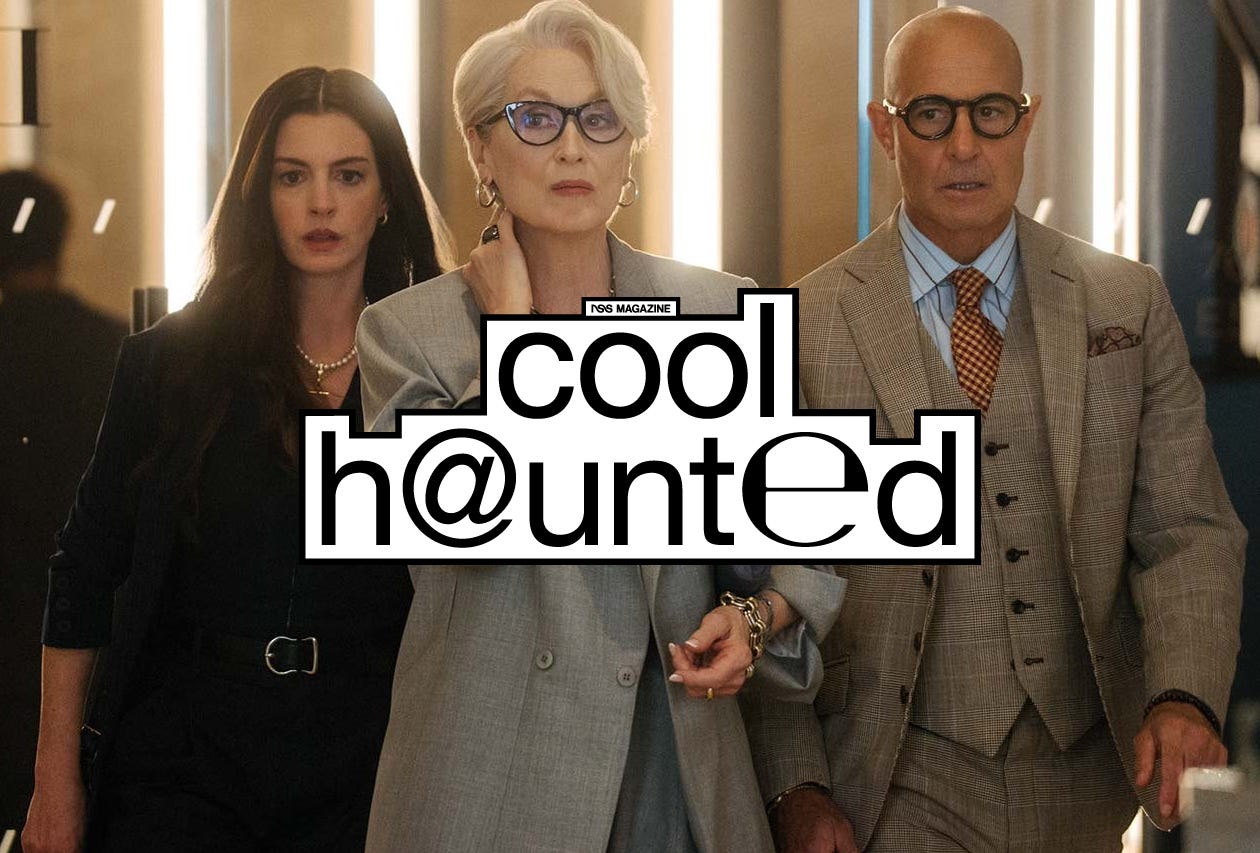
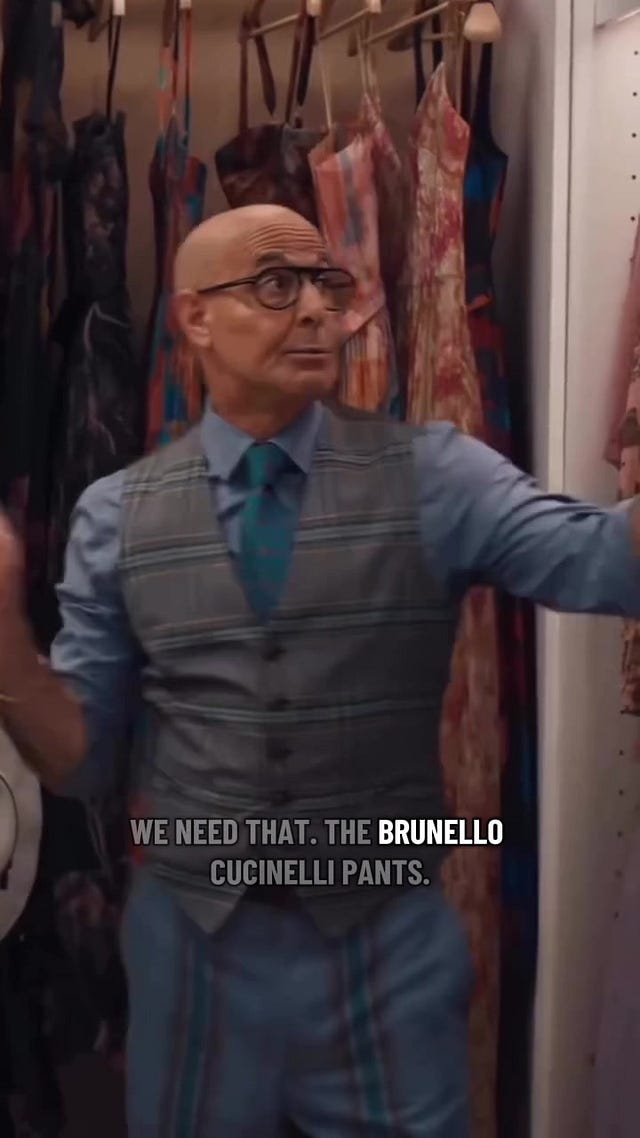
In the latest trailer for the highly anticipated The Devil Wears Prada 2 we see the character of Nigel, played by Stanley Tucci, styling Andy Sachs by pulling pieces from various brands out of a large wardrobe: the first is Fendi, quite predictable; followed by Brunello Cucinelli (“We loooove that,” comments the character) and finally Toteme. A significant choice, since these are the only brands mentioned in a trailer that in just over 48 hours has surpassed 6 million views and that, therefore, enjoy extremely high visibility in the film’s communication.
The only other brand mentioned is Chanel, whose garments Andy Sachs has given away because they were too “important” for her editorial job. A choice that Miranda’s new assistant comments on with shock: “Who gives away Chanel?” But in a film with such high impact, whose filming involved Milan Fashion Week itself, a Vogue cover in which Meryl Streep posed alongside Anna Wintour, and product placement worth tens of millions (we’ll have to see how much of a blockbuster the film will be, but it looks like it will be), the name-dropping of brands reflects the change taking place in the world of luxury.
While in the 2006 film screenwriter Aline Brosh McKenna mentioned fairly conventional brands, later immortalized by the film’s most famous lines, the brands cited in this sequel’s trailer speak of a new luxury world in which it is no longer just the big fashion houses dominating the scene, but a multipolar ecosystem of brands. The hegemony of the major names appears to have weakened in favor of a more fragmented scenario. But what picture of today’s fashion does The Devil Wears Prada 2 seem to offer?
In the first The Devil Wears Prada, the brands mentioned were highly institutional: Chanel, Dolce&Gabbana, Valentino, Calvin Klein, and Hermès are the first that come to mind, in addition to Prada, of course. Along with Miranda Priestly’s vintage pieces by Bill Blass and Dennis Basso, it was a relatively mainstream and recognizable fashion that spoke of pop brands in a rapidly expanding industry: it was the prosperity preceding the 2008 crash, the moment of the it-bags, flashy accessories, and bling.
In the sequel, some things have remained the same but many others have changed. Would a brand like Brunello Cucinelli have had a place in the first film? Probably not, but now that it has become a global player, it has launched its own it-bag, and above all is increasingly cited and mentioned in the ultra-luxury discourse, its inclusion makes perfect sense. The inclusion of Toteme is also indicative: the Swedish brand is among those that, riding the quiet luxury wave, have expanded the most in recent years, first becoming a commercial success, then the emblem of a contemporary luxury alternative to that of the big Parisian and Italian brands.
The fashion landscape that the film now seems to describe is much broader than in 2006. Alongside Dior and Armani garments, the new trailers are full of pieces by Dries Van Noten and Rick Owens; there’s a Phoebe Philo t-shirt and a sacai skirt, as well as pieces by AGOLDE, Gabriela Hearst, Monse, and Ulla Johnson, to name just a few. These choices demonstrate that, in the golden age of magazines, the truly famous brands were the most canonical ones, while today we see a fragmentation of the market — that is, a transition from a concentrated industry driven by a few mega-brands to a multipolar landscape, where dozens of micro-markets coexist with different logics of price, identity, channel, and perceived value. But what has changed?

 Tiktok failed to load.
Enable 3rd party cookies or use another browser
If, thanks to social media, fashion has become practically part of the entertainment industry (a phenomenon that the 2006 The Devil Wears Prada effectively helped create), the new digital media that appeared between the original film and the sequel have led to an extreme fragmentation of the luxury landscape. At the time of the first film, it made sense to focus on the most mainstream names, because brands like Maison Margiela, Helmut Lang, or Comme des Garçons would have been unknown to a large part of the audience, even though they were just as relevant as Valentino, Armani, Fendi, and all the others.
According to a report by the Boston Consulting Group, Gen Z, which represents 40% of fashion spending in the US, buys on average from 15-20 brands per year compared to the ten per year they bought in 2005. They discover them mainly through social media and influencers and are 1.5 times more likely than those over 28 to discover brands via social media and 1.3 times more inclined to judge a brand’s status based on follower count or social engagement. Above all, the new generation makes product-driven choices rather than brand-driven ones, preferring parameters such as price, quality, durability, and comfort over mere heritage or brand history.
Already a year ago, McKinsey’s The State of Fashion 2025 report indicated that only 29% of Gen Z’s wardrobe came from the same brand, while for those over fifty the percentage rose to 52%. Only 33% of the latter had said they explore and buy new brands, compared to 50% of Gen Z. Therefore, not only is an increasingly high percentage of new consumers effectively indifferent to heritage, but what analysts see as market fragmentation represents for many a plurality — that is, an increase in valid options to choose from.
It is no coincidence that Brunello Cucinelli and Toteme are two extremely product-driven brands, recently popularized by influencers. In this sense, the film already seems to describe from the trailer a double parallel trend that is dividing the fashion market. The first is the polarization between high-end and aspirational luxury. Product-focused brands, just like Brunello Cucinelli but also Hermès or The Row, are growing at double-digit rates at a time of crisis for mega-group luxury. The other is the rise of the segment defined by BoF as “advanced contemporary”.
Toteme is in this sense the symbol-brand of that mid-market luxury which, according to the latest The State of Fashion 2026, «is the fastest growing segment, replacing luxury as fashion’s main value creator». In Andy’s wardrobe, this trend is also signaled by the inclusion of Golden Goose boots and several pieces from the New York brand TWP by Trish Wescoat Pound. Even Miranda wears Jacquemus heels, which BoF includes among the best-known brands in the accessible segment, along with Aritizia, another brand seen on Andy Sachs.
Then there is the world of the major brands, represented in the trailer by the name-dropping of Fendi and Chanel. Fendi is a brand that, let us remember, despite generating low organic media buzz outside viral moments like the centenary show or Maria Grazia Chiuri’s debut, remains absurdly popular on social media thanks to secondhand: the Baguette is among the 10 most searched bags of 2025 on Fashionphile, while a few days ago Vogue described how the Spy Bag has become more expensive and thus more sought-after on The RealReal after its reintroduction on the runway.
Meanwhile, Chanel is mentioned by Andy Sachs when she says she gave away (resold?) her old pieces, indirectly mentioning the existence of a secondhand market. Elsewhere, among the costumes of Andy Sachs seen in paparazzi photos there is a second-hand 1990s Jean-Paul Gaultier suit and an 1980s Coach Metropolitan Briefcase. Could it be that the film’s costume designer, Molly Rogers — who is once again replacing Patricia Field, as she did with And Just Like That — wanted to tell us something about the state of contemporary fashion through the scenes of a film that precisely talks about generational change and fashion at the crossroads between traditional print media and new digital media? We can only hope that the screenplay lives up to the wardrobe.