


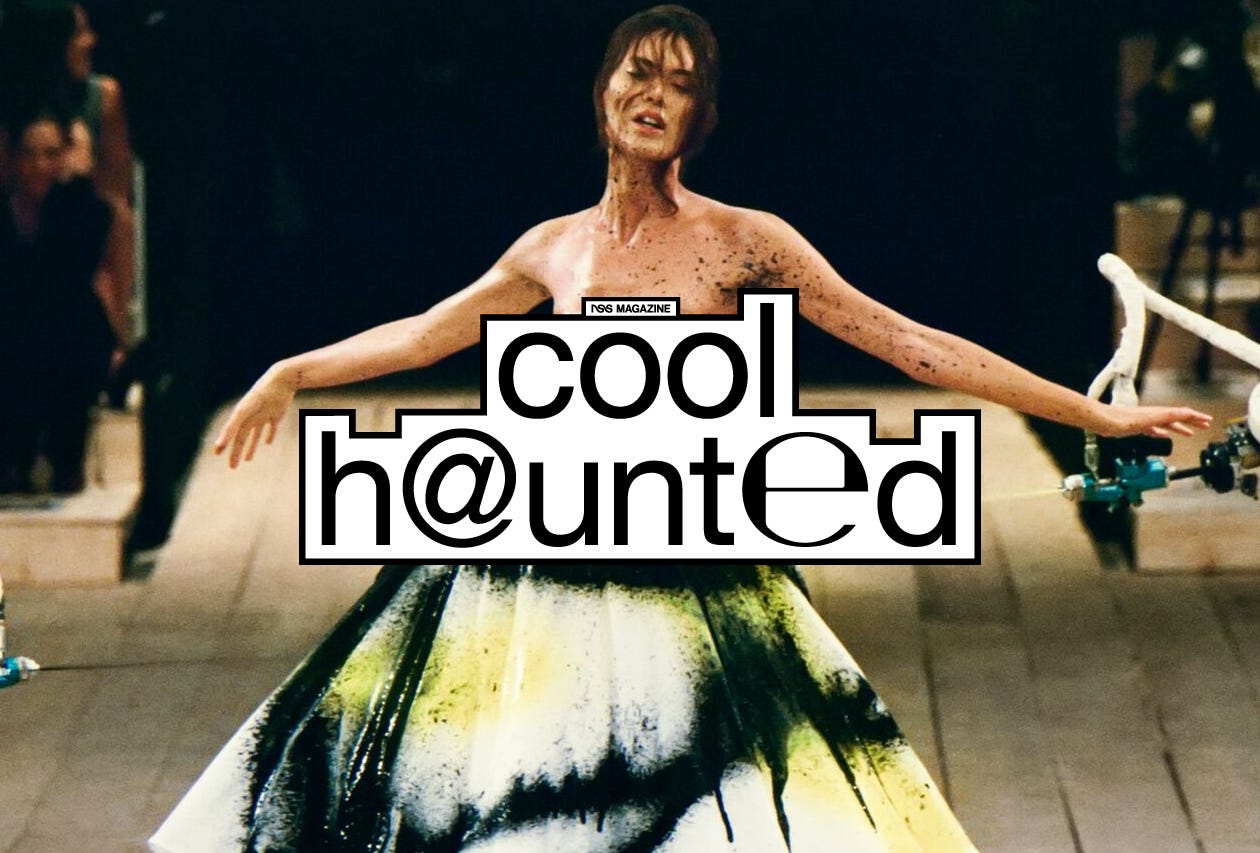
McQueen is a brand that every fashion lover cannot help but love. For many Millennials, Lee McQueen’s shows were precisely the first and most spectacular point of contact with fashion. His designs have influenced culture in ways we often don’t imagine (Tilda Swinton’s dress in the first The Chronicles of Narnia was a blatant copy of a McQueen runway piece, for example) and the tragic end of his story has forever sealed his story with the sense of fatality typical of all great legends.
Lee McQueen left behind a brand that today is in more than one difficulty, that is searching for a new creative director and that, crucially, has a cult following among fashion enthusiasts. But the most passionate of all is John Matheson, an American in London, who has collected and assembled one of the most extraordinary archives of garments and media related to the legendary Lee and, several years ago, opened the Instagram page @mcqueen_vault which today is approaching 200,000 followers.
The page is the best point of access to McQueen’s history that exists on social media, so much so that it has turned Matheson into a consultant and researcher. When McQueen’s last creative director, Sean McGirr, left his position two weeks ago, Matheson shared his thoughts on the brand in a series of Instagram Stories. And given his privileged point of view on the brand and its heritage, we contacted him asking him to elaborate on his thoughts. This is what he told us.
What do you think of the situation the brand is in now?
John Matheson: About a year ago, a report came out saying that the brand was overly reliant on trainers. To me it was always quite tragic: most young people know McQueen for shoes, not for his design legacy and rich heritage. So there was already a huge problem from the outset, with that single item becoming so predominant in the business. That best-seller was eroding a lot of what was worked on so hard for over twenty-some years. That’s a hard thing to pull back once that train has left the station. Between the massive footwear contribution and a niche, quite wealthy circle of people buying embroidered or overly decorated formalwear and evening wear, other areas of the business were left super vulnerable.
It’s unfair to place all of the blame on Seán McGirr. He inherited a very problematic position. Even though I didn’t love his first show, he was clearly trying to do something completely different. But the next season he backtracked into the cliché: strong shoulders, everything in black, lace, Victorian collars. It wasn’t believable. There wasn’t conviction in what was being done. It was a bit of a cosplay of what someone thought McQueen should be.
But what should McQueen be?
John Matheson: Ironically, not the theatrics. Nor the cliché hourglass silhouette with strong shoulders. It would be how the garments interplay with the body. Was there a lot of thought given to the cut? Do I see movement? Are the garments in flow with how the body is moving? Anything that follows a convincing idea of anatomy and structure?
And one of the most crucial things is balance. Lee McQueen talked a lot about balance in his work. There was a very recognizable balance in the silhouette. Whether it was a high-platform shoe or a weird heel, all of that carried through from top to toe. If I were able to see that structure, that anatomy, that balance, that conviction in what they’re doing, I’d think, “That’s McQueen.”
People have a very narrow idea of what McQueen is: this gothic, Maleficent-style cliché caricature. They expect maybe a little tartan, maybe a little white lace. It always cracks me up that people forget the lightness, the humor, the joy, the love, all the things on the opposite side of the darker aspects of what he did. Someone has to be able to come in with that entire range of vision and channel it in the right way because, in order to challenge the status quo, you have to have that field of view to be able to move beyond it. At its heart, McQueen is about a connection to human craft, quality, spirit, emotion, love, sex, all of that.
What do you think about the names that are circulating about the next creative director?
John Matheson: There are three or four names being thrown out on social media but I don’t think any of them are suitable. Anyone who’s already copying the work of McQueen should not be considered to work for McQueen. Why would you go to the brand to do that all over again, if you’re already using that aesthetic where you are?
So who should be the next creative director?
John Matheson: Someone well known as a technician, or someone who pushes the envelope in silhouette, construction or fabric innovation and not someone who’s just fun to talk about on social media. We are tired of this endless cycle of people coming in and out. For that reason, I wish they wouldn’t name a creative director. I wish they would follow a much smaller model that allowed the business to reset what it’s about and refocus on the quality of what it’s making. That’s not going to happen, I know how fashion works. Ironically, it doesn’t like to try new things.
I would really like someone who is able to do something cohesive and maybe reset where the brand is and just show us some really cool, fascinating, mysterious clothing again that we can fantasize about and get excited about. And that should be done without relying on a corset, black lace, leather, all these clichéd things. You can do all that, fine, but everybody does now.
What if the brand just closed?
John Matheson: You can’t just say “close the house.” That’s not realistic. I know it’s fun for the fans to say, “Lee said this,” but he also said in a later interview that he had hundreds of people to provide for and to help pay their mortgages [Matheson refers to Lee McQueen’s interview for Love Magazine’s Issue 3 - “The Fashion Icons” in 2010, ie]. A corporate business is not some whimsical thing where you get to push the stop button whenever you don’t like it anymore. They could decide to close it but the brand would be broken up and the archives sold off. In many respects that would be far worse than taking a different direction.
What would need happen to make the brand name regain its strength?
John Matheson: Possibly regrouping back in London, starting out small, doing smaller shows, offer a smaller collection and trying to bring a specific authority to the name again. I’ve seen an effort in that lately, but there’s nothing beyond reformulated archival reissues. I also think they need to pull back from the show schedule for the moment, strip things back and rebuild. But given how cash-strapped they are, I don’t know how realistic that is, because they need money.
What do you think innovation should look like?
John Matheson: It would need to be something that still makes the wearer identify with the design. In many cases that might mean playing with the lines of the body, something that augments or exemplifies the shoulder through to the waist, integrating construction into garments that pushes the silhouette in a different way. What are you doing to actually reinvent what a lapel does, or how the neckline interacts with the body of a garment? The internal anatomy of a shoulder? Those are the things that still excite me when I see a garment in real life. And I think there’s still the opportunity to do something like that.
You also suggested that the house could turn into a foundation or a school. Why is that?
John Matheson: Every single person who comes to London and follows my page sends me a message saying, “Where can I see Alexander McQueen when I come to visit London?” Most of the time the answer is, you can’t. There is so much heritage and design history within the house, especially from a truly British perspective. I’d love to see them create something that outlives seasonal fashion offerings, whether it’s a foundation or a permanent museum.
It would be cool if they did a hybrid model: something resembling a foundation-slash-museum, but with limited capsule releases of either re-editions or new designs. It could be really innovative, sitting slightly outside the Fashion and Exhibition world, but also crossing over into something that can still offer very high-end pieces to clients. I don’t know if that has ever been done before, but it could be quite fascinating.
McQueen’s shows were themed. Do you think they could be a device to bring people in and make the collection readable?
John Matheson: The themes of shows were why people could identify with his aesthetic and his vision so easily. It was very clear, cohesive messaging. Every season you had a collection name and a theme that was very easy for the audience to follow throughout the show. To me, that connects right back to what I was saying about current designers: they don’t have conviction in what they’re trying to portray.
So they throw a bunch of stuff out, hoping the customer will identify with one or two pieces. But the theme drove the collection, the marketing, the ad campaign, the accessories. Everything was super, super clear. It’s a sign of confidence for a creative person to be able to do that. When it’s not there, you can tell. There’s no point of difference in most of the shows now.
And what do you think about the critics’ biases about the brand today?
John Matheson: It’s a funny predicament to be in, because brands want to control the narrative, but they can’t and they won’t be able to. So you’ve got accounts out there that are saying it exactly like it is (some with authority and many without), and fashion people don’t want to hear negative comments or critiques anymore, because not many journalists write actual critiques. I understand there is a difference between an honest opinion and cruelty, and I shared this in my very first review of McGirr’s time at the house. Brands aren’t able to control that aspect of social media, and it’s having a huge impact on how people experience fashion, because the audience mostly want entertainment They don’t necessarily want a great garment anymore.