



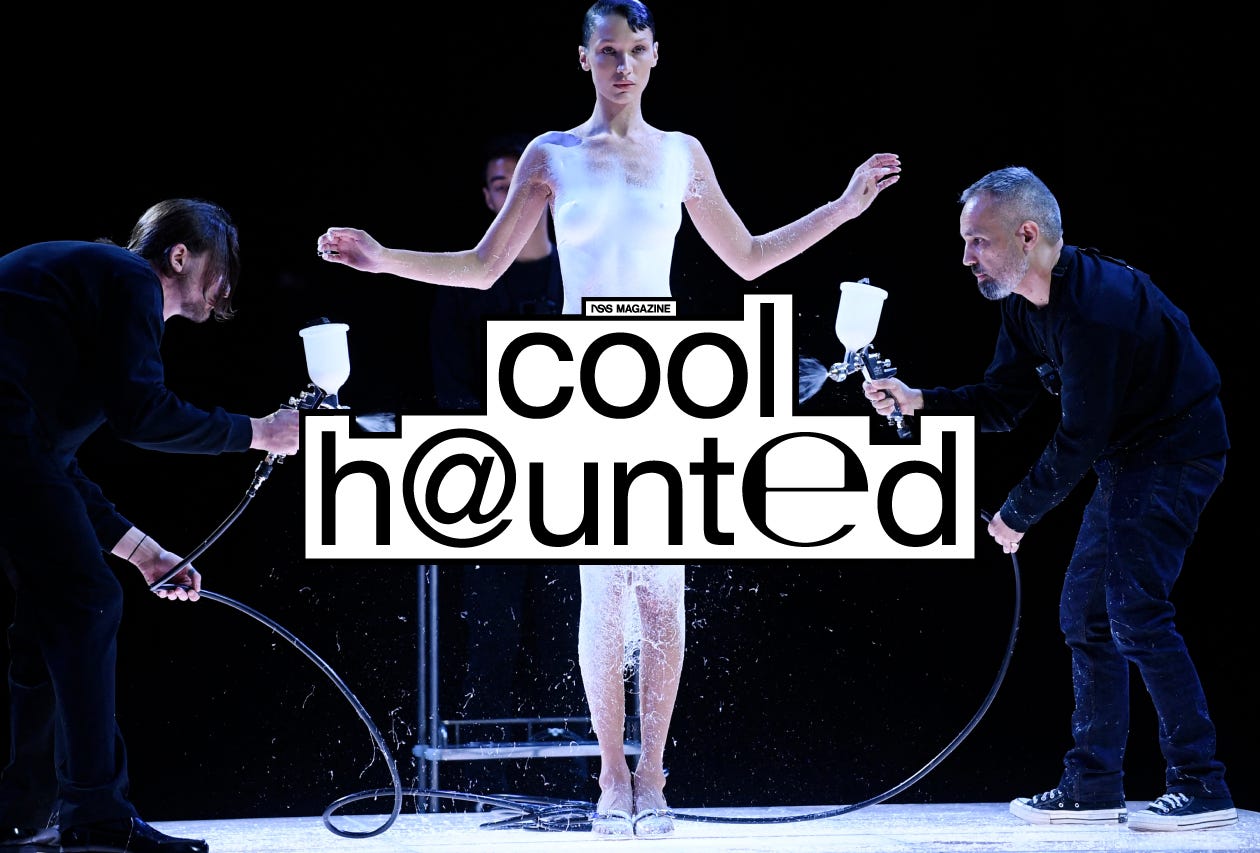
If high tide lifts all boats, low tide is the first to run smaller ones aground. In short, this is what has been happening in fashion over the past few weeks, as the luxury crisis has begun to claim victims among the most fragile links in the food chain: independent brands. And if global giants such as LVMH and Kering have their own (and not insignificant) headaches, imagine what happens to those without the same financial backing. The most prominent case in recent weeks is undoubtedly that of Coperni, which has more or less definitively shut down. But it is not the only one.
Charles de Vilmorin has also entered judicial liquidation, while Vaillant Studio, founded by designer Alice Vaillant, is undergoing restructuring proceedings. Shortly before that, Hungarian label Nanushka announced that it had significantly scaled back its operations due to mounting debt and losses. In recent months, Martine Rose had also experienced serious production problems, once again because of the same operators behind Coperni; Sunnei entered judicial liquidation in May, while Bally is now caught between moratorium proceedings in Switzerland, provisional insolvency administration in Germany and the closure of its historic factory in Ticino.
These are different stories, including from a legal standpoint, but they share several common features: all these brands have attracted attention, made headlines and secured a place on official fashion week calendars. Yet they have failed to turn this cultural capital into a healthy business. To understand why, we need to look at the common causes behind their many difficulties.

Starting with Coperni, a brand whose downfall has been analysed in depth by nss magazine, we could argue that its collapse was rooted in its corporate structure. Since 2019, British wholesale platform Tomorrow Ltd had been the brand’s licensee, exclusive distributor and majority shareholder. Under this arrangement, Tomorrow collected all revenues, paid royalties to the brands in its portfolio (including Martine Rose and Charles Jeffrey Loverboy) and reimbursed expenses unrelated to design, such as fashion shows and campaigns.
When Tomorrow’s wholesale business deteriorated, the company stopped paying the brands their share of revenues and the reimbursements they were owed. Tomorrow’s financial accounts were critical: in 2024, revenue had fallen by 34% to £8.4 million, gross margin had dropped from 76% in 2023 to 41%, and operating losses had increased by 28% to £7.5 million. These problems remained hidden until they eventually came to light, with the sudden cancellation of the FW26 show. Coperni itself had also lost €5 million in revenue over two years and, when payments from Tomorrow stopped altogether, the entire financial system collapsed.
Nanushka, meanwhile, the Hungarian label known for its vegan leather and understated bohemian silhouettes, announced just days before Coperni that it had scaled back its operations under the weight of debt and losses. Until 2021, the company was in good financial health, with revenues of €34 million. Its drive for growth led to heavy investments in stores and large order volumes which, amid the war in Ukraine and the slowdown in the multi-brand retail business, pulled the proverbial rug out from under the brand, leaving it suddenly exposed. Divisions among investors further exacerbated the situation.
The situation surrounding Charles de Vilmorin is more opaque. Celebrated as a couture enfant prodige and, for a couple of years, also as creative director of Rochas, the designer had cancelled his eponymous brand’s show after leaving the house, citing «significant changes» and announcing a possible return for the July couture season. Two years earlier, the designer had established a new company, Studio Charles de Vilmorin, while the previous one had been dissolved. But last June, the new company once again entered liquidation. According to Glitz, the brand is expected to return (where there’s life, there’s hope, after all), although we do not know when.
Vaillant Studio, founded in 2020 by Alice Vaillant, also entered judicial restructuring proceedings this summer, with an observation period running until December 2. We do not know the brand’s precise financial details, but the fact is that if it were able to meet its obligations, it would not be undergoing this type of restructuring. These cases, together with those of Bally and, to some extent, Martine Rose, are only the latest examples in a longer chain of more or less structural difficulties affecting emerging brands over the past few years, including Opening Ceremony, Band of Outsiders, The Vampire’s Wife and Christopher Kane, as well as Y/Project.

Normally, when an independent brand starts running into financial trouble, the discussion immediately turns to the argument of «virality versus sales». It is true that investing too heavily in brand perception when sales do not justify the stakes is a mistake. But in reality, this is the most superficial of the problems, to the point that we would only attribute it to Coperni, the only brand to have produced more than one fashion moment while consistently facing criticism for its lack of product substance.
In any case, the brand was generating €10 million in annual revenue: without the entire corporate structure fiasco and with more accurate management, it might still be around today. Perhaps Nanushka offers more food for thought. In five years, partly thanks to investors, the brand’s revenues multiplied thirty-fourfold. Things began to go wrong after that initial wave of growth: excessive pressure to expand led to risky bets.
Here, the problem concerns investors, who sometimes seem to ignore the very lessons of their own industry: no luxury brand has ever become a phenomenon by flooding the market with products and opening flagship stores. The first boom is always cultural. Success comes when a particular creative direction (Ford and Michele at Gucci, Jacquemus, Demna at Balenciaga, Blazy at Chanel) responds to the needs of its time, and fades when those needs change. For an independent brand, it is better to have demand that it cannot fully satisfy than supply that it cannot sell. And this brings us to another source of difficulty: the wholesale market.


The fundamental problem with much of the wholesale market during these years of crisis is the flawed distribution of the risks associated with distribution and sales between retailers and independent designers. This has turned multi-brand retailers from strategic partners into uncomfortable intermediaries. In negotiations with them, small brands have very little room for contractual manoeuvre, leaving them on the front line when problems arise. Between 2024 and 2025, online multi-brand retailers collapsed one after another: Matchesfashion, Farfetch, Saks Global and SSENSE all dragged numerous independent brands into their own crises, with unpaid invoices sending shockwaves throughout the market.
But perhaps the biggest problem is the imbalance in contractual conditions imposed on small brands by large retailers, on whom the fate of these brands often depends: extended payment terms, razor-thin margins, logistics costs borne by the brands themselves and little flexibility when it comes to renegotiating agreements. There is also a disparity in the distribution of risk: designers must pay upfront for the development and production of collections that retailers then sell with full control over sales conditions, pricing and distribution. And because brands cannot afford to jeopardise vital sales channels, these conditions often become a form of extortion.
On top of this, there is an entire constellation of other problems, starting with orders reduced or cancelled by buyers after designers have already committed to factories, or excessive order requests that create burdensome obligations, as well as the management of sales and discounts, often applied unilaterally by retailers. But in all of this, what are the independent designers entering the market today actually doing?

In September, speaking to BoF, young designer Zane Li, founder of LII, explained that he wants to develop his brand organically. He has no interest in outside investors, nor in dressing celebrities: «We don’t want to get that kind of attention and then not be able to catch up with our product offering». His words echo those of another successful independent designer, Emily Bode, who told Vogue in 2019: “It’s been so important for me to not have investors at this point, to scale it really naturally, to keep it very close to me as we scale.”
As it has grown, Bode has consistently chosen to build its own distribution autonomy, relying on a small number of trusted multi-brand retailers. Sigurd Bank, founder and creative director of mfpen, one of the most successful independent brands of recent years, has also spoken extensively about the subject on the Throwing Fits podcast: «I never had any debt in the company. I never had any investors or anything.» The same ideas have also been echoed over the years by Cassie Holland of HADES, Diek Pothoven and Douwe de Boer of Martan, and Sonia and Maurice Mosseri of denim brand Still Here.
The mindset of an entire generation of designers therefore seems to have changed. In the previous decade, following the meteoric rise of Virgil Abloh and his protégés, emerging designers tended to believe in easier, more scalable business models. In today’s luxury crisis, things are different. The new dimension of luxury is no longer about becoming a global phenomenon, but about becoming local: being able to produce at a measured pace, embracing prudence and never taking on more than one can handle.
Too many international funds have tried to resurrect defunct brands, burning through millions only to end up empty-handed; too many “new phenomena” walk the fashion week runways while being financially on the brink. Above all, consumer demand has shifted towards pieces with genuine value rather than fleeting novelties, destined to be abandoned like disposable toys. But the real distrust seems to be directed at big capital: in turbo-capitalism, financing has become synonymous with losing one’s identity.