


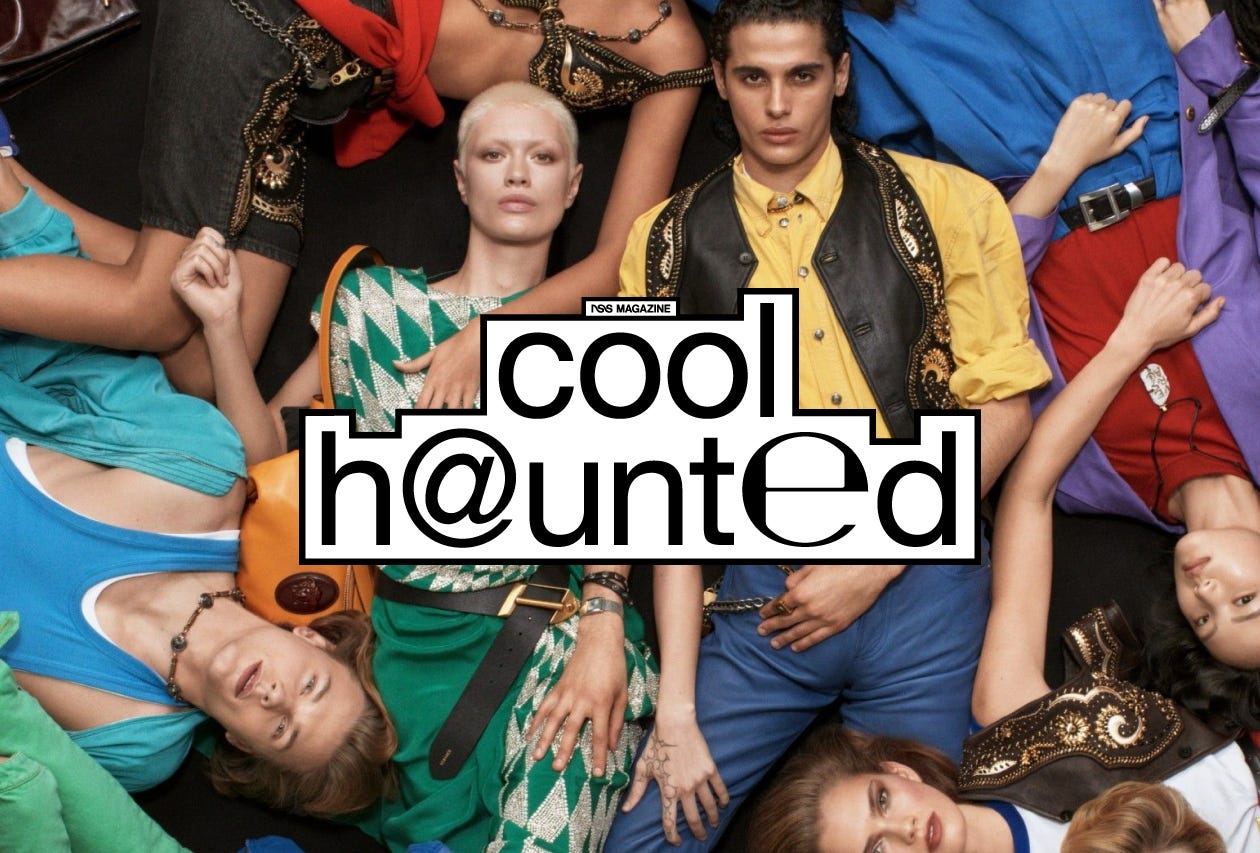
In life, the best tastes are the ones acquired. And the same can be said of the Versace SS26 collection, today remembered with the more practical nickname of “Versace by Dario Vitale”. When it was presented, with a more intimate show than many expected, it initially divided public opinion. A grand reinterpretation of Gianni Versace’s imagery or a simple exhumation of the 1980s in its most shocking colors? It was a strong impression, which however suddenly changed the perception of Versace, wiping out the platinum glamazons and the mega-logoed sneakers that had become synonymous with the brand in recent years. But after the first shock, a second one arrived.
After being at the brand for just nine months, producing a single collection, a sneaker collaboration and an interesting 3-in-1 campaign, Dario Vitale was fired by the new/old owners of the Prada Group who in the meantime had acquired Versace, putting an end to his short season in the sun. Now, the brand awaits the arrival of another no less masterful designer, Pieter Mulier, responsible for Alaïa’s renaissance. In the meantime, the recognizability and fame gained by Vitale, as well as the hundreds of editorials and covers in which the collection appeared, have led industry insiders to talk about a “revenge” for the designer who was a victim of market logic.
The collection is therefore in a very particular position: not only appreciated by insiders and highly recognizable, but also, given the creative director’s rapid exit, almost a limited edition worthy of being collected. There’s more: The fashion community loves an underdog and Dario Vitale is the perfect underdog: young, a respected professional but also a highly appreciated creative who was denied an opportunity by a major industry group right on the verge of a change that will be epochal for Versace.
Yet, we could argue, it was precisely his rapid exit that partly created an almost anomalous appreciation for the collection. Anomalous not for lack of merit, but for the unusual intensity and emotionality it carried. From this story, can we therefore draw some broader lessons about creative directors and the psychology of the fashion public?

«Right from the start, the collection shocked and made people talk about Versace in a completely different way than before», Francesco Rudi of @versaceeventi, the most important fanpage dedicated to the brand, told us. Rudi compared the collection to the silent protagonist of Pasolini’s Teorema since «it catapulted itself into the habitual and repetitive life of each of us and upended it». Rudi continued his comparison: «In Teorema, the guest of the bourgeois family appears unexpectedly, and simply by existing, without too many glances or provocations of any kind, arouses the sexual desire of all the family members. The attraction they feel towards him leads them to experience sides of themselves never tried before».
Just like the mysterious guest in Teorema, Dario Vitale disappeared relatively quickly, leading the brand’s new audience to first develop a real obsession with this great fashion what if. Unlike archive fashion, however, here the collection can be bought: on the website and in boutiques everything is available and, according to Rudi’s information, the collaboration with Onitsuka Tiger was so successful that new colorways will soon be announced. As Rudi says, «it was anything but reassuring for Versace’s typical clientele: it disoriented, bewildered, confused, and in some cases even disappointed» but according to his information «as for sales, it sold. Not only for the aesthetics and the narrative, but also for the exclusivity of the pieces. There will never be another Versace by Dario Vitale. The point is precisely that the fact that Dario left is what made everything more desirable».
Of course, Rudi continues, «the fan of Versace by Donatella, made of baroque prints and excesses, did not always fully identify with Versace by Dario, which was much more appreciated by the brand’s historical clients, i.e. Gianni’s fans, and by the new generations. There has never been so much attention towards Versace from such a young audience». Unlike the very long era of Donatella Versace, for Vitale «everything was based on desire, and on wanting to explore it, on the level of sex, with different codes» but also on practical goals since «the goal [of Vitale, ed.] was not to aspirationally dress talents for the Met Gala, but to reach people’s homes».
For Rudi «the problem with Versace by Donatella is exactly what happens to every artistic movement: when it reaches its peak, before fading and making way for the next one, it becomes exasperated. She did the same, she took all the characteristics of Versace to exasperation: bondage, prints, leather… everything». Without managing «to move away from the old Hollywood myth to explore new and innovative forms».



The cultural effects of Dario Vitale’s Versace were fundamental realignments of the notion of desire at the base of the brand itself. Even before his early exit, the collection was at the center of covers around the world, ended up on all conceivable celebrities (from historic faces like Julia Roberts to the new face Connor Storrie) and received validation from mega-stars like Addison Rae, Robyn and Dua Lipa, obliquely managing to become an instant cult for the queer community.
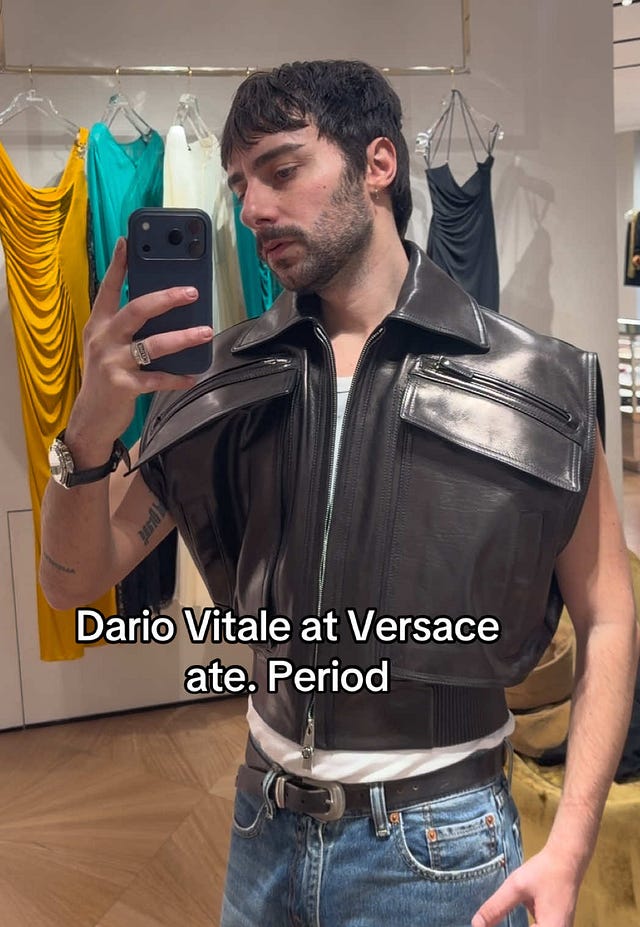
In many ways, Dario Vitale’s Versace exists in the same extended imaginary as the works of Tom of Finland and Fassbinder’s Querelle. And together with Chanel’s, the Versace SS26 collection was the only other one that pushed numerous editors and insiders in the system to show up in store, try on the collection and post about it on social media. A truly rare thing today.
The reason for this interest is surely the sense of exclusivity Rudi spoke of, i.e. the actual temporal limitedness of a collection that will have no follow-ups or replicas and, therefore, already when it appeared in stores it resembled one of those Supreme drops that pushed fans to make a pilgrimage to the store. Entering and exiting in nine months and signing a single collection, Dario Vitale’s Versace may not have been able to express its full potential but, at the same time, it was immediately delivered to fashion history as a unique phenomenon.
On the narrative level, this creative era cut so short did not appear broken, but miraculously concise. In an era in which creative directors who debuted in the last year have already signed five or six collections in as many months, Dario Vitale’s single collection was not weighed down by insistences, redundancies or commercial exasperations.
Something similar, although less commercial, had happened when Jean-Paul Gaultier entrusted the Haute Couture collections to different guest designers each season, creating a series of unique event-collections and for this reason memorable. Considering that in recent years changes of creative director have become more frequent in tandem with the decrease in the duration of mandates assigned to designers, could we look at this phenomenon as the announcement of a new model?

 Tiktok failed to load.
Enable 3rd party cookies or use another browser
The role of the creative director has changed a lot in recent years, becoming celebrity, ending up at the center of gossip, being announced as the saviors or redeemers of this or that brand. Today’s great debate revolves around the question of how much power to assign them. LVMH and Chanel, for example, like to invest in a solid creative direction and turn their creatives into superstars - it is no coincidence that Pharrell also appears in campaigns and collaborations of other brands in the group and Jonathan Anderson has signed a talent contract.
Kering, on the other hand, is re-discussing the power of these figures: after the shock caused by Alessandro Michele’s exit from Gucci, which led the brand to three years of creative confusion now concluded with Demna (hopefully), the new CEO Luca De Meo immediately said that the fate of a brand cannot be tied to a figure whose rapid turnover is now a consolidated factor to be planned for, with an average change every 5 years or less. According to rumors, his proposal was to entrust creative directors with the image and about 20% of the brand’s production, leaving everything else in the “safe” of carry-over collections and guaranteeing a form of continuity. According to this reading, creatives are both an asset and a liability, both a resource and a risk.
Of course, even though there are many examples of luxury brands that work even without the protagonism of a creative director, these are still very specific brands, which perhaps produce only bags or shoes. But it would be worth entertaining the thought: since the logic of the market has changed, the logic of fashion itself should also change. The brands of mega-groups and independent designers are, after all, now completely different creatures, not even remotely comparable and if the latter still need an authorial voice, the former have implicitly renounced authorship for some time, delegating and spreading decision-making power through increasingly capillary structures.
In this sense, the case of Dario Vitale at Versace could represent the serendipitous realization that a single and very intense season, when well calibrated, can have a much higher impact than a decade-long creative direction that however churns out new products every three months, eventually losing that factor of specialty and uniqueness that a “one-act play” could instead have. Which however would entail a complete change of pace in the narrative of the entire industry. But it would be appropriate to ask whether the market is not moving from an idea of price exclusivity to one of time exclusivity.