



For many years, the tank top was the garment that nobody really wanted to admit they loved because it was considered too simple to be called fashionable and too ordinary to become an object of desire. It was there, in everyone’s wardrobe, but it never received much attention: hidden beneath a shirt, worn during workouts, chosen on the hottest days when the only rule was surviving the heat. Then, as so often happens in fashion, someone decided to take a closer look at what seemed the least interesting, and that is how the tank top became both the most democratic and, at the same time, most talked-about piece of the summer.
A garment that can cost just a few euros or become a luxury product, one that can be associated with manual labour, the gym, ‘90s minimalism, or the runways of the world’s biggest fashion houses. And this year, those very maisons confirmed the tank top’s evolution from a basic staple to a central element of the wardrobe. The interesting point, however, is something else. The tank top appears to be a neutral garment, almost devoid of personality. Yet simply changing the cut, the fabric, or the way it is styled can transform it completely. So, does a tank top really say who we are?
Let’s start with the most recognisable one. The gym bro tank top is not simply sportswear. It often features technical fabrics, cuts designed to allow greater freedom of movement, and a fit intended to enhance the physique. Its original function is practical, but in recent years fitness aesthetics have moved beyond the gym, making their way into streetwear and everyday fashion. With Balenciaga’s Resort 2026 collection, Pierpaolo Piccioli revisited the founder’s construction-focused approach to create a series of luxury athleisure pieces, including a look featuring a sporty tank top that follows the body’s anatomy.
In FW26, Gucci, the tank top was reinterpreted through a more sensual lens, using glossy, textured surfaces that distance the garment from its athletic origins. Tank tops with a silicone-like finish, with shiny, almost liquid-looking surfaces, blended seamlessly with the models’ physiques, following the contours of their muscles and transforming the garment into a futuristic second skin.


A more minimalist approach comes from Courrèges, the maison that has turned the tank top into one of the defining pieces of its wardrobe. In the SS26 collection, the classic tank top was reinterpreted through stretch cotton styles, both jersey and ribbed, while preserving the maison’s signature language of clean geometries, body-hugging silhouettes, and a sensuality built on the relationship between skin and fabric.
This type of tank top belongs to the kind of person who might start a conversation with “I’m bulking” even though nobody asked. Or to someone who spends more time in front of the gym mirror than under the barbell. Behind this aesthetic lies an important cultural shift: the world of sport has profoundly influenced contemporary fashion. Sneakers, leggings, technical fabrics, and athletic silhouettes have become everyday staples, making the line between the gym and the street increasingly blurred.

The classic white tank top looks like the easiest garment in the world to wear, and perhaps that’s exactly why it’s one of the hardest to pull off. When a piece of clothing is extremely simple, every detail becomes essential: the quality of the cotton, the shape of the shoulder, the length, and the way it falls on the body. The ribbed tank top has arguably undergone the most interesting transformation. More classic than its sporty counterparts, it carries with it an aesthetic rooted in manual labour and the men’s wardrobe.
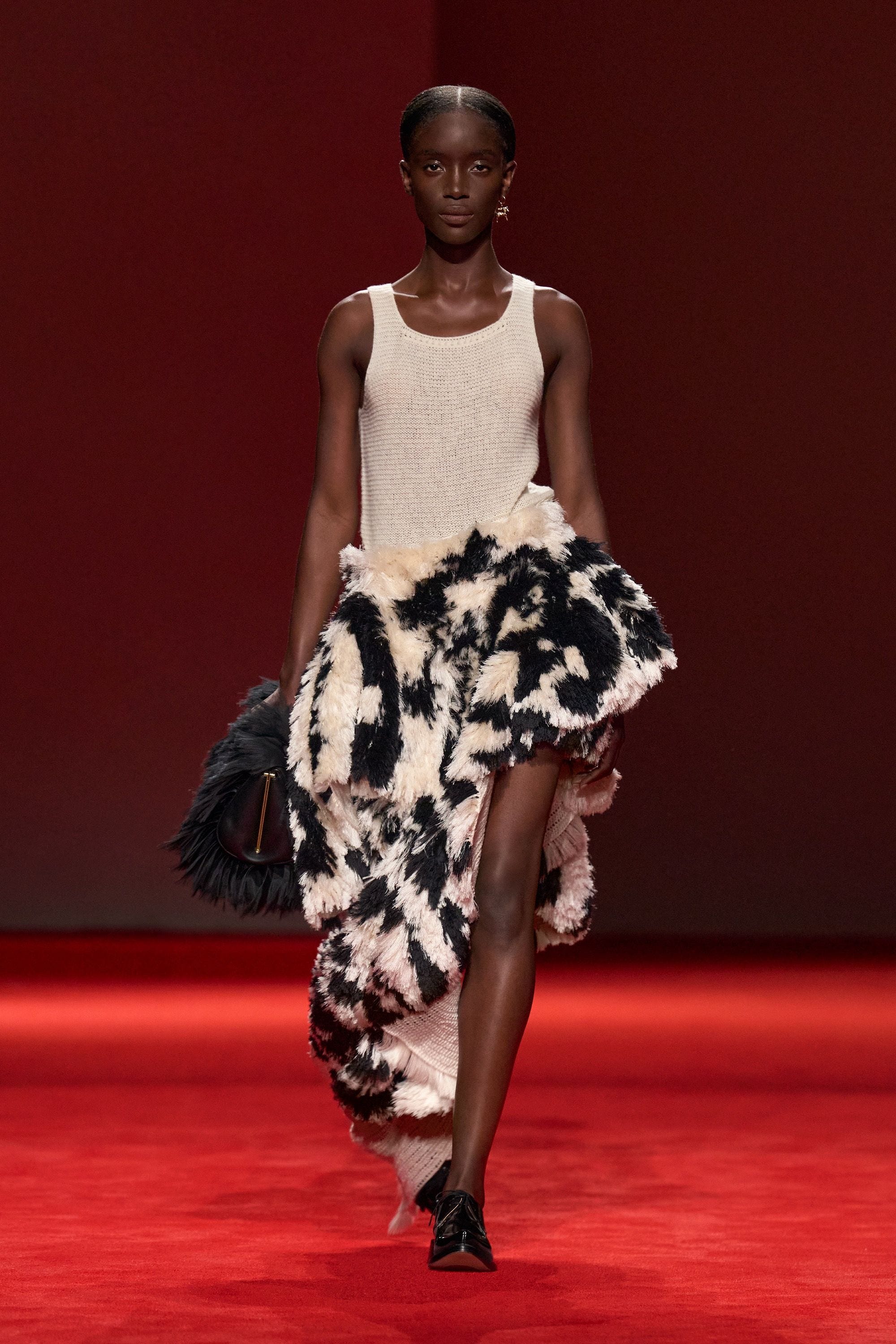
Yet today, brands have reinvented it by creating a vintage-inspired aesthetic that looks to the past without truly trying to recreate it. It’s a filtered version of the past, where the tank top is paired with tailored trousers, statement jewellery, oversized blazers, and luxury accessories. Its strength lies precisely in this contradiction: it is the perfect example of how contemporary fashion loves to take everyday items and turn them into symbols.
White tank tops appeared in both Fendi’s Haute Couture collection and Balenciaga’s, while Vetements, Saul Nash, and above all Dolce&Gabbana and JW Anderson also brought them back in their SS27 collections. A white tank top also peeked out from beneath unbuttoned shirts in Tom Ford’s Pre-Fall 2026 collection, in Stella McCartney’s Resort 2027, and in Bottega Veneta’s FW26.
Looking effortless often takes a great deal of effort. Loose and relaxed, the oversized tank top immediately conveys a sense of ease. It is the answer to an era in which a wardrobe is no longer expected simply to flatter the silhouette, but also to express a certain attitude. The rise of this style is closely tied to American streetwear in the 2010s, when brands like Yeezy transformed the concept of basics into an exploration of proportions.
And then there’s the extra-oversized version. While the first retains the garment’s recognisable structure, simply making it wider through the torso and softer in shape, the second pushes volume to the extreme. The almost endless armholes inevitably recall the tank tops worn by construction workers in August: hanging off their shoulders, stained with cement, and completely soaked with sweat by eleven in the morning. The difference is that, in the fashion world, that very same silhouette is styled with tailored trousers and £1,000 trainers.


Versace, in Dario Vitale’s debut and final SS26 collection, reinterpreted the oversized tank top through a far more relaxed sense of sensuality, with exposed torsos and silhouettes inspired by the maison’s archives. Throughout the SS27 season, oversized versions also appeared at Yohji Yamamoto, Kiko Kostadinov, and Rick Owens, each with its own avant-garde interpretation. More decorative and embellished were those by Dries Van Noten, Egonlab, and Simone Rocha during her Florence show. A white tank top made of ultra-light organza also appeared in Chanel’s Spring Haute Couture collection.
Of all the tank top’s transformations, the lingerie version is perhaps the most elegant. It reflects an important shift: what once had to remain hidden can now take centre stage. Silk, lace, sheer fabrics, and delicate straps are no longer invisible layers.
This interplay between underwear and outerwear is one of the recurring themes of contemporary fashion. Lingerie is constantly being reinterpreted because it allows designers to create contrasts: something delicate paired with something structured, a feminine garment combined with a masculine element. Lingerie worn as outerwear is the new obsession inspired by the 2000s style of celebrities and similar cultural figures.
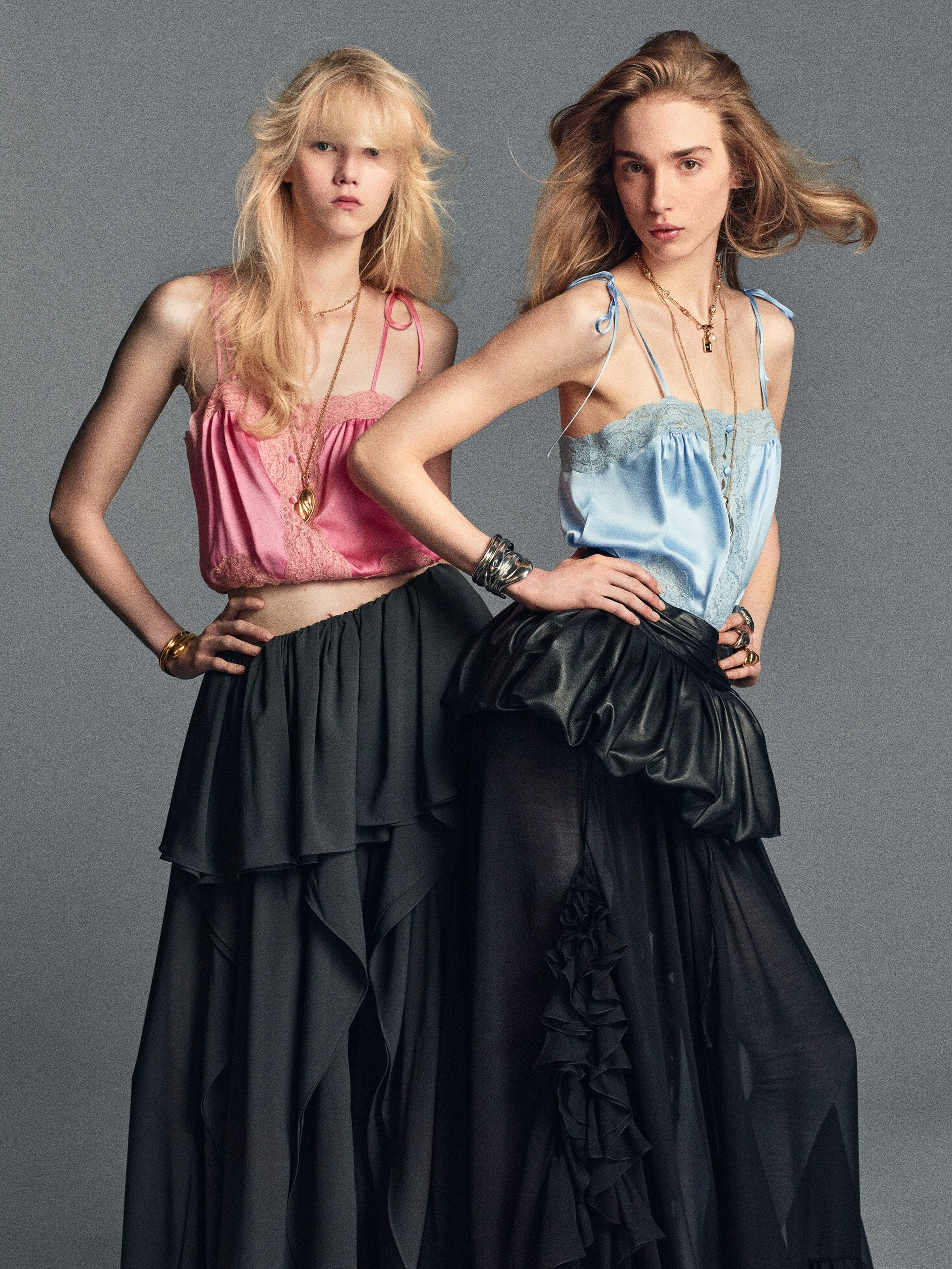
We are talking about one of the strongest womenswear silhouettes of the season, presented, for example, in Dior’s Resort 2027, Chloé, and sacai, as well as in Saint Laurent’s Pre-Fall 2026 collection and in Miu Miu’s FW26, which is perhaps one of the brands most specialised in lingerie designed to be worn externally. Perhaps even more interestingly, a deconstructed version also appeared in Maison Margiela’s SS26 collection.

There is a tank top that is never worn on its own but serves purely as a styling element. It is the one that appears as soon as temperatures rise above thirty degrees and the asphalt begins to melt. It can be made of linen, lightweight cotton, or crochet, perhaps in neutral shades: white, light blue, sand. It is the tank top of someone who, even if they are still in the city, is already mentally by the seafront. It belongs to an ideal wardrobe that includes oversized sunglasses, soft trousers with a tailored feel, and an open shirt worn over it.
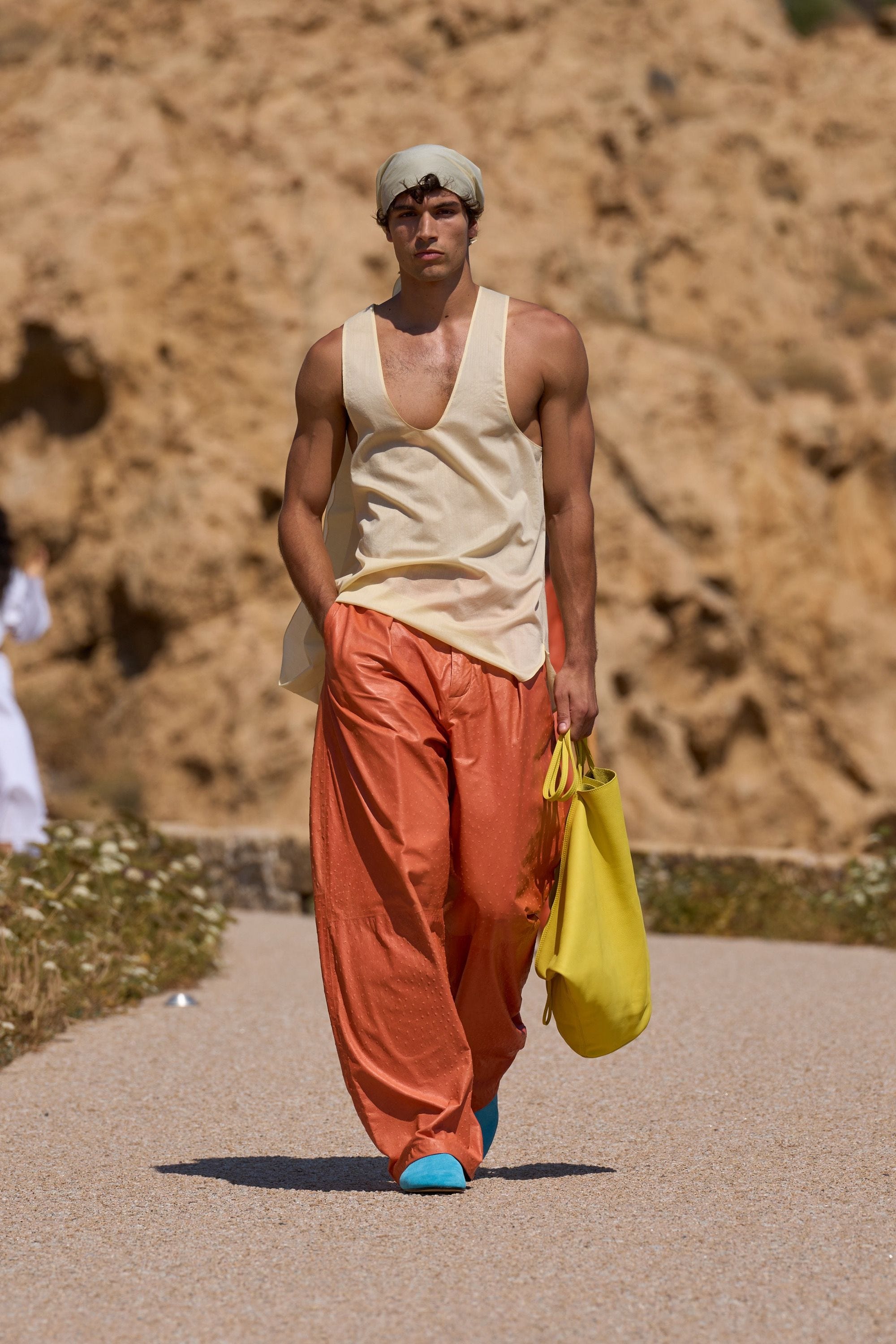
Similar versions appeared in Jacquemus’ SS27 collection, presented in Corsica, where the tank top was reinterpreted through more sophisticated versions made from thin paper-effect leather, bonded crêpe, and organza-crafted details. It is the tank top of someone who, while on holiday, allows themselves what would seem out of place in the city: a particular texture, a brighter colour, a more precious fabric.
It is one of the most interesting versions because it describes a very intimate relationship with clothing: it wants to simply suggest a feeling. A slow afternoon. A sunset spritz. A day without schedules. In practice, a better life than the real one.
Perhaps no other garment better represents a contradiction of contemporary fashion. Spending a lot on something that, at first glance, appears extremely simple. At a time when luxury is increasingly shifting towards the appreciation of materials, construction, and quality, with a designer tank top the price is worn openly on display.


From Prada to Miu Miu, passing through Loewe, The Row, Toteme, and Saint Laurent, the designer tank top has become an everyday small luxury as well as a highly profitable category. Prada uses its most recognisable element: the enamelled logo triangle, generally placed on the chest or side of the tank top, or a simple triangle applied on the back. Miu Miu often embroiders or applies its own logo in a smaller format on cotton pieces; Loewe identifies its most recurring symbol as the logo made up of four interlocking “L”s, which can appear as tone-on-tone embroidery or a discreet detail on the fabric. Saint Laurent, on the other hand, adds the Cassandre logo, the three interlocking YSL letters created by Adolphe Mouron Cassandre in 1961, as a small metallic detail or embroidery on tops and tank tops.
Often true luxury works in reverse: it is something noticed only by those who know. It is the same logic that has led the fashion world to reassess jeans, white T-shirts, and other everyday garments, based on the idea that what matters is not how complex a piece is, but how carefully it has been made.