


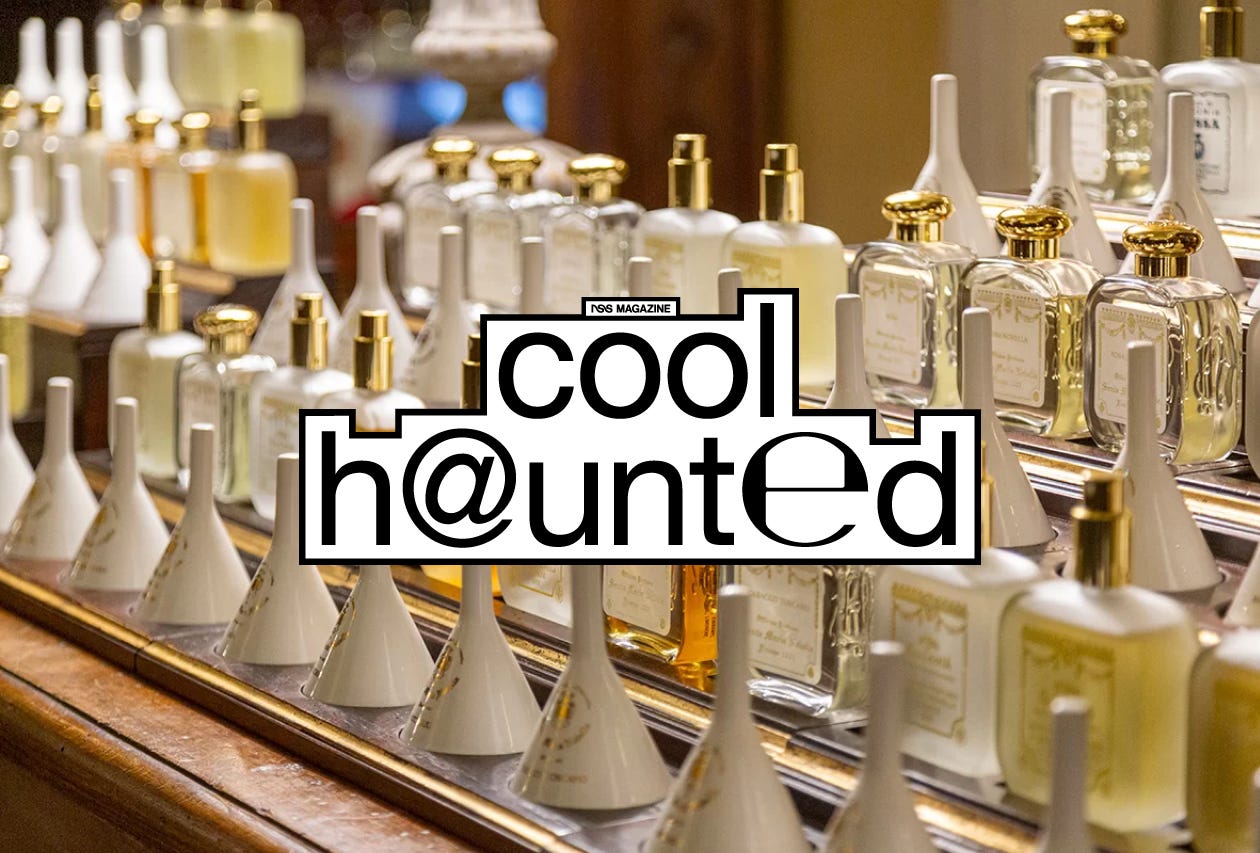
The history of the Officina Profumo-Farmaceutica di Santa Maria Novella dates back to 1221, when twelve Dominican friars were granted the use of Santa Maria inter Vineas, just outside the walls of Florence, and created a botanical garden intended for the convent’s infirmary. More than eight centuries have passed since then. In 1612, the pharmacy opened to the public, and in 1871 it officially became a private company under the name it still bears today. The Officina continues to operate in the same locations in Florence and has built much of its image precisely around its continuity with that past. This is why the appointment of Formafantasma, the design and research studio founded by Andrea Trimarchi and Simone Farresin with offices in Milan and Rotterdam, as Creative Directors feels rather unexpected, at least at first.
If there is a brand that seems to know exactly who it is, it is probably the Officina Profumo-Farmaceutica di Santa Maria Novella. And so the question comes quite naturally. What is a creative director supposed to direct when the identity they are faced with has already existed for more than eight hundred years?

Andrea Trimarchi and Simone Farresin, founders of the Formafantasma studio, will work on products, packaging, communications, retail spaces and events—essentially, everything that allows the Officina to present itself to the public today. The two have explained that their work will start from what already exists, seeking to understand what has allowed the company to remain relevant for so long and how that same history can continue to work today. And this is precisely where their appointment becomes interesting even beyond the world of design. A creative direction role of this kind operates in a territory much broader than traditional design. It encompasses branding, communications, retail, image and strategy, here applied at the scale of an entire company. At the same time, this appointment also explains why a brand like the Officina is choosing to establish a creative direction now. The beauty industry continues to be a growing market and, in particular, fragrance and perfumery are growing globally. The Officina therefore finds itself in a particular position, with an already very strong identity but still plenty of room to grow and become more international. At this point, creative direction also serves to understand how to support that growth without losing consistency.
In recent years, we have talked extensively about creative directors in fashion, the constant changes at major Maisons, their transformation into public figures and the increasingly important role they play in shaping the perception of a brand. The role has meanwhile expanded so much that the collection has become just one of the many things they have to hold together.
It would be a stretch to interpret this appointment as the moment when the creative director leaves fashion behind for the first time. Since September 2023, Formafantasma has also overseen the creative direction of Gruppo Rubelli, the historic Venetian company operating in the world of textiles, furnishings and coverings. What has really changed, then, is the weight of the role. The creative director has gone from being primarily a technical figure, often working within the company, to becoming a name with an identity of their own, followed almost like a director, musician or artist. Their fame can exist outside the company they work for and, when they move elsewhere, they bring with them an audience, an imaginary and a set of expectations.
The examples go far beyond European luxury Maisons. In 2025, Ray-Ban appointed A$AP Rocky as its first Creative Director, entrusting him with a role spanning collections and campaigns through to the design of the stores themselves. In 2021, FWRD had chosen Kendall Jenner as Creative Director, giving her responsibility for the platform’s image, brand selection, marketing and activations. The model has even reached football, where for the 2025/26 season RSC Anderlecht entrusted Mosaert with its creative direction, in a project encompassing jerseys, music, campaigns and the club’s identity. At that point, the creative director becomes something more than a figure who decides how things should look. They are responsible for the brand’s image, but also an ambassador and increasingly a public representative of the brand. It is a shift we had already begun to explore during Design Week, when this figure was described as a cultural platform, capable of moving across different disciplines.

Today, the Officina is much more than the romantic image of a Florentine pharmacy frozen in time. Italmobiliare entered the company in January 2020, and in recent years the brand has accelerated its retail and international expansion. In 2025, it reached €74.4 million in revenue, with growth of 6.3%, while in the first half of 2026 revenue reached €34.7 million, 6.7% more than in the same period of the previous year. Today, it is present in more than 30 countries with 40 directly operated stores. It is therefore already an international company, but it is at a stage where its scale could change considerably.
The market is helping too. McKinsey forecasts that beauty will grow by around 5% annually through 2030 globally, and that fragrance will overtake makeup, becoming the third-largest beauty category by size. For a company with perfumery at the heart of its identity, this means operating within a market that still offers considerable room for growth. This is where creative direction begins to have a very concrete meaning. The more markets, stores, products and channels increase, the more points of contact there are through which the brand’s identity can expand.
The official statement shared by the Officina about Formafantasma’s appointment points in exactly the same direction. They are described as “careful curators of the knowledge that the Officina has safeguarded for eight centuries”, a heritage made up of ingredients, formulas and gestures, with the task of understanding how this heritage can continue to evolve. The word curators probably describes better than any other what creative direction means in this case. It means understanding what should be carried forward from such a long history, how to tell that story and how to make it work in ever-changing contexts.
This is probably also why Formafantasma are such an interesting choice. For years, their work has revolved around the processes behind objects, raw materials, supply chains and systems that normally remain hidden. Their first monograph, published by Phaidon in 2026, follows the same approach. The book reconstructs the research, conversations and relationships that generated the projects, rather than simply lining up the objects produced over more than fifteen years of work. Applying this approach to the Officina means having centuries of formulas, ingredients, packaging, archives, spaces and stories to examine before even thinking about something new. Creative direction thus increasingly resembles less the gesture of an author imposing their own style and more the work of someone deciding what to bring to the foreground, what to connect and what to carry forward.

In recent years, the creative director has become an increasingly common answer to the problem of identity. The channels through which a brand communicates have multiplied, from retail to social media, from e-commerce to collaborations, while the relationship with the public has also changed. Today, audiences expect a continuous, recognizable and consistent presence. At the same time, competition has become much broader, making it increasingly difficult to stand out through the product alone. For this reason, identity can no longer be left to individual moments or separate departments, but needs someone capable of bringing together image, tone, spaces, content and the way the brand presents itself.
In fashion, creative directors are asked to make huge Maisons recognizable, to continuously produce cultural moments with enormous media reach. In the case of Formafantasma’s appointment, something different—and perhaps even more interesting—is happening: the identity already exists and is probably the company’s most important asset. Having more than eight hundred years of history, however, does not automatically determine what a store in New York should look like, how packaging should appear online, or how to introduce a new product without turning the past into mere aesthetics.
Formafantasma’s appointment is the first sign of something larger. If a company with more than eight hundred years of history feels the need for a creative direction, it is easy to imagine that in the coming years more and more companies outside fashion will do the same, entrusting a single figure with the task of bringing together product, image, culture and public presence. If a creative director can serve luxury Maisons, eyewear brands, football clubs and centuries-old pharmacies, how long will it be before the role stops being associated with fashion and simply becomes one of the central roles of any contemporary brand?