



Leggi l’articolo in italiano
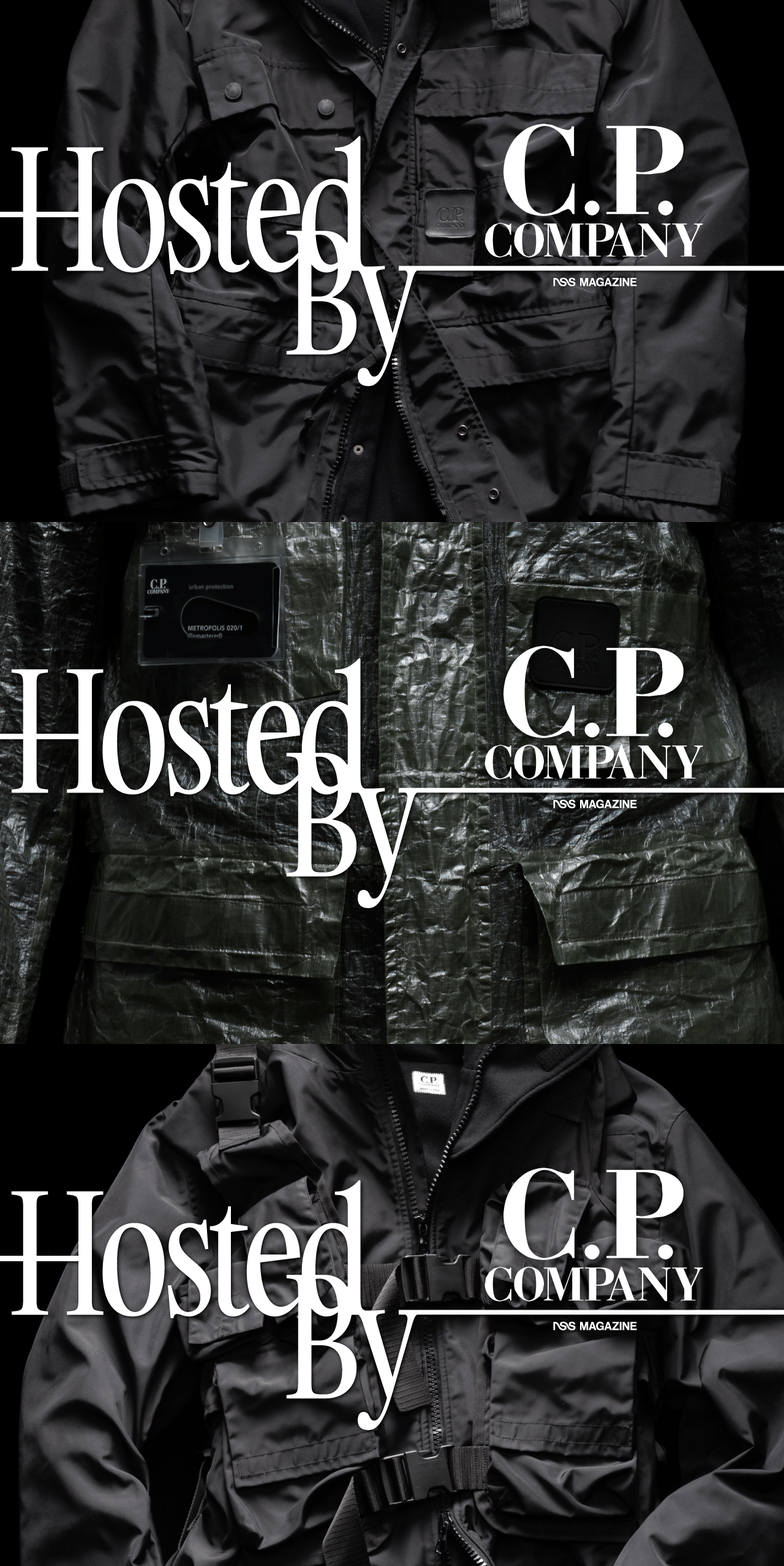
Cities change, habits change, and clothing changes with them. Since its foundation in 1971 by Massimo Osti, first under the name Chester Perry, C.P. Company has approached design as a way of reading the present through function, research and material experimentation. Over the decades, the brand has become one of the defining names in Italian sportswear, not for following trends, but for turning the realities of contemporary life into garments.
It was precisely this research-driven approach that made possible one of the brand’s most significant eras: Urban Protection, a collection that redefined what clothing could mean in the modern city.
When Moreno Ferrari was appointed Creative Director in 1997, he shifted the collection’s focus away from the garment-dyed natural fibres that had defined much of the label’s identity, towards a harder, more industrial vocabulary, one better suited to the anxieties of a city approaching the new millennium.
Where earlier C.P. Company collections had interpreted everyday life through utility, colour, and fabric research, Urban Protection reframed clothing as a system of defence: a response to the instability, pollution, and social fragmentation of the late 1990s metropolis. Ferrari’s starting point was the street itself:
I like going to markets, to pubs, to down and out places, and analysing people and social changes. That’s where Urban Protection started. Massimo Osti had his colli bolognesi, and that was his world and aesthetic. I made the Metropolis jacket to say that C.P. Company has to acknowledge the dystopic city as well.
That observation led to a rigorous process of material research. As Ferrari explained, the work began from a deep analysis of safety workwear and the relationship between fabric and polluted environments. The result was Dynafil TS-70, an oil-proof, stab-proof and rip-proof black nylon developed for industrial environments, which became the signature material of the collection and the foundation upon which its entire visual language was built.
From there, Urban Protection expanded into a fully formed universe of garments and accessories conceived for urban survival. Gas masks, emergency alarms, torches, pollution detectors, and headphones were not applied as futuristic decoration, but integrated as functional devices, each one evoking a particular aspect of the modern city as a site of tension, vulnerability and adaptation.
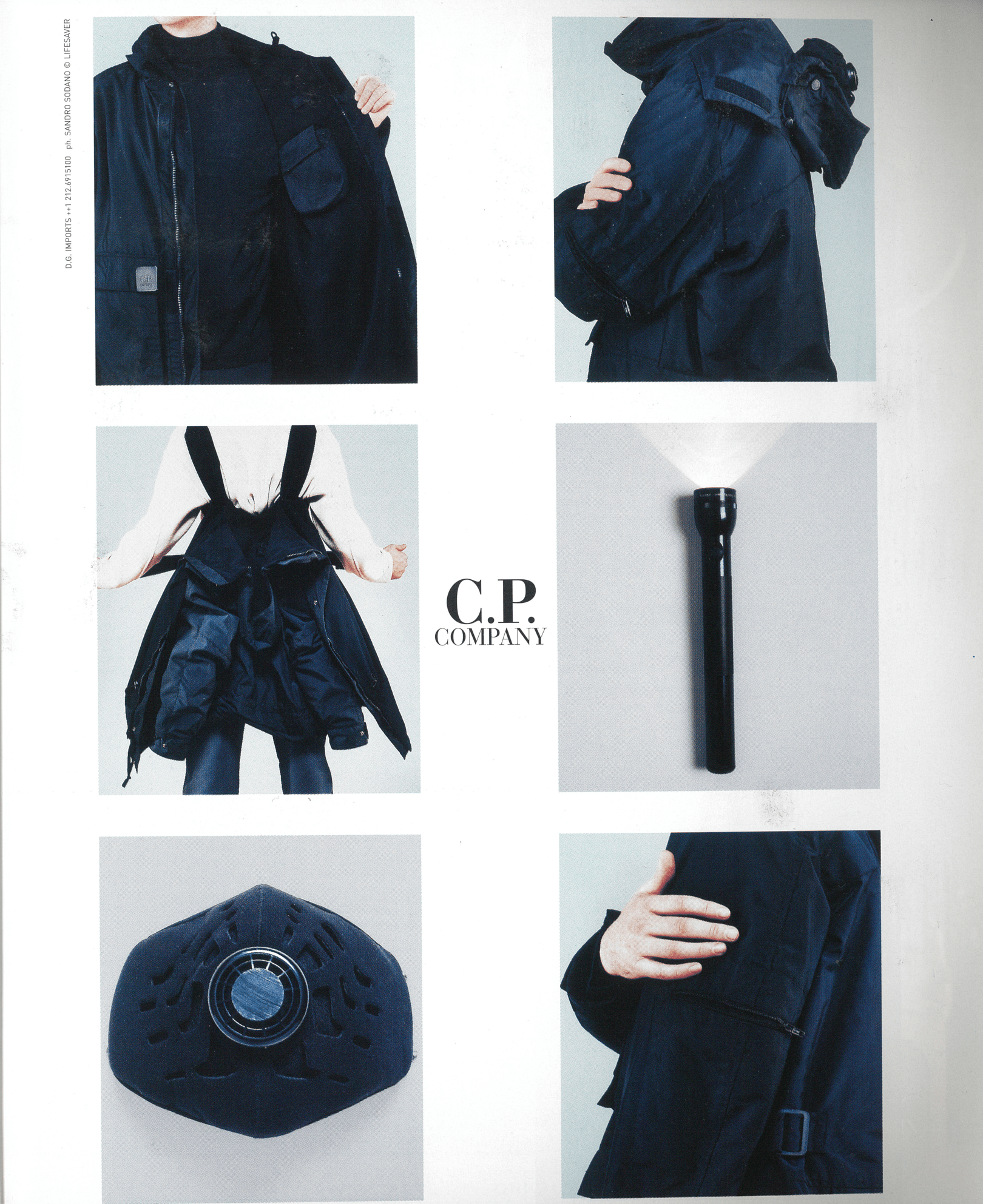
At the centre of this vision stood the Metropolis jacket, first released in SS99. More than any other piece, it crystallised the collection’s central proposition: that clothing could operate as an interface between the body and the urban environment, mediating between exposure and protection, visibility and anonymity. But in the collection, two other objects capture this vision particularly well, each from a different angle.
The Rest, from FW00, was a backpack that converted into a stool. Designed by Ferrari for waiting in the modern non-spaces of contemporary life - airports, transit zones, the anonymous thresholds of the city - it treated urban endurance not as a metaphor, but as a practical problem to be solved.
The Beekeeper coat, from Autumn/Winter 2000-01, operated on a different register entirely. Modelled on an apiarist’s garment and dedicated to Pier Paolo Pasolini, it introduced a poetic dimension to the collection, born from the tension between rural and urban, between a disappearing Italy and the dystopian city he was designing for.
Together, they define the range of Urban Protection: rigorous and functional on one side, culturally aware and deeply personal on the other.
Urban Protection’s underlying questions soon pushed Ferrari beyond the boundaries of conventional outerwear. The Transformables range, first released in Spring/Summer 2000, pushed that research into entirely new territory.
Made from transparent polyurethane or a rubberised rip-proof two-layer nylon derived from competitive cycling rain shells, the Transformables were objects that refused to stay still. Vests became backpacks, capes became hammocks, jackets became inflatable chairs, kites, sleeping bags, or tents. Ferrari described his ambition in a conversation with Cristina Morozzi in 2000:
I hate heavy things. I hate walls. Instead, I am chasing after my dream of lightweight cities. Ideal, precarious cities, disassembled and packed away in moments by crowds of nomads. Imagine a city that can appear and disappear in the blink of an eye. These jackets are my architecture. I can’t construct from reinforced concrete, but I can build with the same materials as military tents. In this way, my buildings are also weak, but that means that they are able to tackle delicate subjects: emotions, loves, enthusiasms, and delusions.


Each Transformable carried a deeply personal association. Ferrari was particularly fond of the jacket that transformed into a sleeping bag – for him, a symbol of freedom, independence and nomadic experience. The tents, meanwhile, were inspired by a scene from the French arthouse film Corps à Coeur, directed by Paul Vecchiali, in which a man waits outside his beloved’s house in a tent. That image was enough to convince Ferrari to design an entire range of objects around the emotion of waiting. The jacket that turns into a kite, he says, is «my soul.»
Ferrari’s creative era at C.P. Company remained a defining moment in the brand’s history, but its underlying questions never disappeared. Decades later, the brand returned to that same proposition with Metropolis Series, relaunched in 2020 and named after the jacket that had come to define the original collection.
The premise remains one of protection, but the terms have shifted. Where Urban Protection responded to a specific moment of late twentieth-century anxiety, Metropolis Series reframes that concern in more architectural and enduring terms. Clothing is conceived not as a mask, but as a shield: a structure that allows the wearer to move through the urban environment while preserving discretion, autonomy, and identity.


The collection resists the rhetoric of hyper-visibility that defines much of contemporary fashion. It proposes instead a quieter idea of presence, one grounded in continuity and function rather than spectacle. To understand what Metropolis Series is trying to do, it helps to think about clothing differently.
The cultural theorist Marshall McLuhan argued that garments are not merely coverings, but extensions of the skin itself: mechanisms that regulate exchange between the body and its surroundings while defining the social self. Metropolis Series takes that idea, translating it into a language of essential forms, resilient construction, and purposeful protection.
Where fashion often celebrates transience, Metropolis Series insists on endurance. Clothing conceived not as a seasonal statement, but as infrastructure: built to last, designed to support life in the city with intelligence, resilience, and measure.